
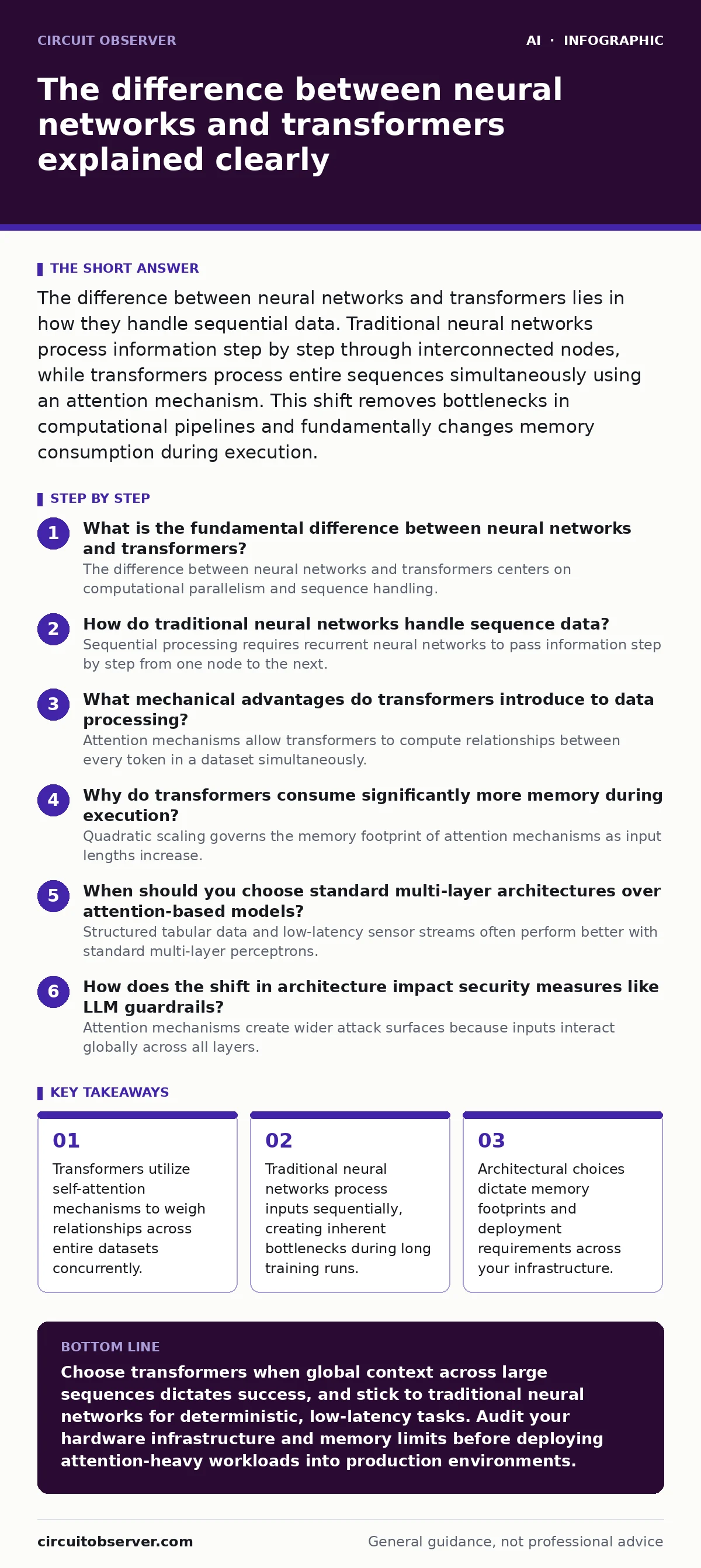
The difference between neural networks and transformers lies in how they handle sequential data. Traditional neural networks process information step by step through interconnected nodes, while transformers process entire sequences simultaneously using an attention mechanism. This shift removes bottlenecks in computational pipelines and fundamentally changes memory consumption during execution.
What is the fundamental difference between neural networks and transformers?
The difference between neural networks and transformers centers on computational parallelism and sequence handling. Neural networks process data sequentially through layers of artificial neurons, whereas transformers analyze entire inputs at once through mathematical equations called attention mechanisms. Artificial neurons pass weighted signals forward through activation functions, creating directional pathways for feature extraction.
Attention mechanisms bypass these strict directional pathways by computing direct mathematical relationships between every token in an input space simultaneously. Global context emerges naturally without forcing information through narrow serial bottlenecks. Computational pipelines transform from rigid assembly lines into wide matrices capable of absorbing vast quantities of unstructured data. Engineers must evaluate whether their specific workload requires sequential ordering or concurrent contextual mapping before selecting an underlying architecture.
How do traditional neural networks handle sequence data?
Sequential processing requires recurrent neural networks to pass information step by step from one node to the next. Long sequences cause earlier context to vanish because the hidden state degrades over time through repeated mathematical transformations. Recurrent connections prevent parallel execution on modern hardware accelerators because each step must finish before the next one begins. Training durations extend significantly when dealing with large datasets containing thousands of sequential time steps.
Gradient vanishing and exploding gradients plague these serial architectures during deep backpropagation passes. Mathematical values either shrink toward zero or grow infinitely large as errors travel backward through numerous temporal layers. Mitigation strategies require specialized gating mechanisms and careful weight initialization to maintain numerical stability. Performance degrades rapidly when models attempt to retain long-range dependencies across extended textual passages or continuous sensor feeds.
| Architecture Type | Processing Style | Primary Scaling Bottleneck | Typical Use Case |
|---|---|---|---|
| Feedforward Network | Static layers | Parameter count | Tabular classification |
| Recurrent Network | Serial steps | Temporal length | Time-series forecasting |
| Transformer | Concurrent | Sequence length | Large language modeling |
What mechanical advantages do transformers introduce to data processing?
Attention mechanisms allow transformers to compute relationships between every token in a dataset simultaneously. Contextual understanding scales across distant elements without relying on intermediate step-by-step memory transfers. Matrix multiplication replaces recurrence, matching the parallel architecture of modern graphics processing units. Throughput increases dramatically because hardware executes millions of calculations concurrently rather than waiting for serial queues.
Token embeddings project discrete inputs into continuous vector spaces where semantic distance reflects conceptual similarity. Positional encodings inject sequence order back into the parallel stream since the underlying multiplication operations possess no inherent sense of direction. Multi-head attention layers run numerous calculations in parallel, allowing the model to focus on grammar, syntax, and semantics all at once.
Why do transformers consume significantly more memory during execution?
Quadratic scaling governs the memory footprint of attention mechanisms as input lengths increase. Comparing every token against every other token creates massive intermediate matrices that quickly overwhelm available video random access memory. Inference overhead demands careful resource planning to prevent out-of-memory errors during peak loads. Traditional feedforward networks maintain a constant memory cost per layer regardless of sequence context.
Batch sizes must shrink proportionally as context windows expand to fit within physical hardware boundaries. Quantization techniques reduce precision from floating-point formats to lower bit-widths, easing memory pressure at the cost of slight accuracy degradation. Caching mechanisms store previous token states during generation phases to avoid redundant calculations, trading physical memory space for faster response times.
When should you choose standard multi-layer architectures over attention-based models?
Structured tabular data and low-latency sensor streams often perform better with standard multi-layer perceptrons. Simple classification tasks gain no benefit from expensive attention operations while incurring severe latency penalties. Edge devices with strict thermal and power limits cannot support the massive parameter counts of modern attention models. Lightweight convolutional or dense networks fit securely within restricted hardware constraints without sacrificing necessary accuracy.
Resource-constrained environments require predictable execution times that massive parallel architectures struggle to provide. Static input vectors bypass the need for dynamic tokenization pipelines and complex vocabulary management. Maintenance overhead drops significantly when managing smaller models containing thousands of parameters instead of billions.
See also: AI in Security Operations: How Machine Learning Detects Hidden Threats
How does the shift in architecture impact security measures like LLM guardrails?
Attention mechanisms create wider attack surfaces because inputs interact globally across all layers. Malicious prompts bypass traditional input filters more easily when models interpret context across ambiguous semantic boundaries. Organizations deploying these models must implement strict LLM guardrails to intercept toxic inputs before tokenization occurs. Standard runtime monitoring fails to catch semantic manipulation embedded deep within large attention windows.
Emerging threats such as shadow AI compound these risks when employees spin up unauthorized instances without centralized security oversight. Unmonitored endpoints expose internal data flows to external extraction attacks. Access controls require continuous evaluation to prevent unauthorized fine-tuning operations that could embed malicious behaviors directly into model weights.
What hidden costs emerge when deploying attention-based systems in production?
Infrastructure expenditures multiply due to specialized hardware requirements and continuous power demands. Cooling systems must handle sustained high thermal loads generated by uninterrupted matrix multiplications. Model drift requires frequent retraining runs that consume massive amounts of electricity and engineering hours. Intellectual property protection becomes difficult as adversaries attempt sophisticated AI model theft to replicate proprietary weights.
Operational complexity demands specialized orchestration platforms to manage distributed clusters of accelerators. Monitoring tools must track token throughput, cache hit rates, and GPU utilization metrics simultaneously to detect anomalies. Latency spikes occur unpredictably when varying input lengths trigger dynamic allocation routines within memory management systems.
How do training requirements diverge between these two computational models?
Pre-training phases for transformers demand colossal datasets and distributed cluster environments running for months. Feedforward networks often train on single workstations using modest datasets for routine classification jobs. Hyperparameter tuning scales exponentially with model size, requiring automated search routines to find stable learning rates. Traditional architectures permit manual adjustment based on straightforward validation loss curves.
Dataset curation requires rigorous filtering to remove bias and toxic content before models ingest millions of web-scale documents. Smaller architectures tolerate noisy data better because their capacity restricts the memorization of anomalous examples. Evaluation metrics differ fundamentally, requiring generative benchmarks and human alignment procedures for large attention models instead of standard accuracy scores.
Key takeaways
- Transformers utilize self-attention mechanisms to weigh relationships across entire datasets concurrently.
- Traditional neural networks process inputs sequentially, creating inherent bottlenecks during long training runs.
- Architectural choices dictate memory footprints and deployment requirements across your infrastructure.
Choose transformers when global context across large sequences dictates success, and stick to traditional neural networks for deterministic, low-latency tasks. Audit your hardware infrastructure and memory limits before deploying attention-heavy workloads into production environments.
Frequently asked questions
Can a traditional neural network be converted into a transformer?
No, because their underlying mathematical structures and data handling mechanics are fundamentally incompatible. Converting models requires rewriting the core architecture to incorporate attention layers and positional encodings.
Why do transformers need positional encodings?
Parallel processing treats all input tokens simultaneously without any inherent sense of order. Positional encodings inject mathematical markers into the data streams so the model understands token sequencing.
Do transformers completely replace convolutional neural networks for image processing?
While attention models excel at computer vision tasks, convolutional networks remain dominant in resource-constrained environments. Spatial hierarchies process efficiently through local sliding filters without requiring expensive global attention matrices.
How does context window size affect transformer performance?
Larger context windows allow models to ingest entire documents, but memory consumption scales quadratically with length. Extended sequences increase the risk of distraction where the model loses focus on primary instructions.
How this guide was produced: written by the Circuit Observer editorial team with AI assistance, checked against the public references listed below, and reviewed when the facts change. See our editorial policy or report an error.