
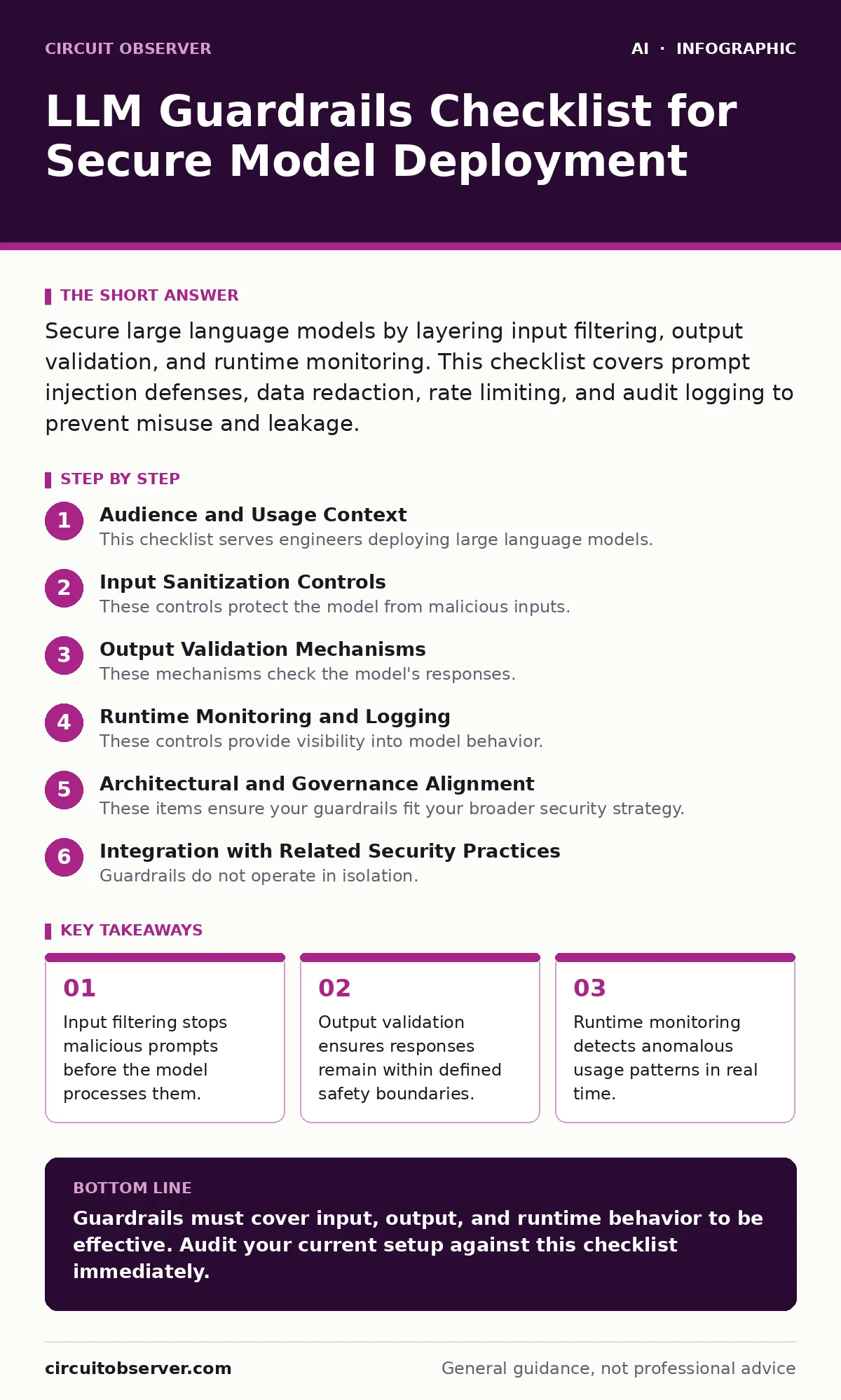
Secure large language models by layering input filtering, output validation, and runtime monitoring. This checklist covers prompt injection defenses, data redaction, rate limiting, and audit logging to prevent misuse and leakage.
Audience and Usage Context
This checklist serves engineers deploying large language models. Large language models are neural networks trained on vast text corpora to generate human-like language. You use this list to verify that your deployment architecture includes necessary controls. Each item addresses a specific vulnerability vector.
Input Sanitization Controls
These controls protect the model from malicious inputs. They prevent attackers from manipulating the model's behavior.
- Prompt injection detection: Blocks attempts to override system instructions with hidden commands.
- Input length limits: Prevents resource exhaustion attacks that overwhelm the processing queue.
- Character encoding validation: Stops attacks that use unusual character sets to bypass text filters.
- Context window monitoring: Ensures the model does not retain sensitive data from previous turns.
- User identity verification: Confirms the requester has permission to access specific model capabilities.
- Sensitive data redaction: Removes personal identifiable information before the prompt reaches the model.
- Rate limiting per user: Prevents abuse by capping the number of requests from a single source.
- Input schema validation: Ensures structured data conforms to expected formats before processing.
Output Validation Mechanisms
These mechanisms check the model's responses. They ensure the output meets safety and accuracy standards.
- Toxic content filtering: Blocks hate speech, harassment, or harmful language in generated text.
- PII detection in output: Prevents the model from revealing personal data it was not supposed to share.
- Hallucination scoring: Flags responses that lack factual grounding or cite non-existent sources.
- Format compliance checks: Ensures code or structured data matches the required syntax and schema.
- Action execution blocking: Prevents the model from directly triggering external systems or APIs.
- Confidentiality boundary enforcement: Stops the model from discussing restricted topics or internal processes.
- Watermarking verification: Confirms generated content includes markers for origin tracking.
- Response length capping: Limits output size to prevent data dumping or resource abuse.
Runtime Monitoring and Logging
These controls provide visibility into model behavior. They help you detect and respond to incidents.
- Audit log retention: Stores detailed records of all inputs, outputs, and metadata for forensic analysis.
- Anomaly detection alerts: Triggers warnings when usage patterns deviate from normal baselines.
- Model drift monitoring: Tracks changes in model performance or behavior over time.
- Access control logging: Records who accessed the model and when, for compliance and security reviews.
- Error rate tracking: Monitors failure rates to identify potential attacks or system issues.
- Resource usage metrics: Tracks compute and memory consumption to detect unusual spikes.
- Session termination controls: Allows administrators to forcibly end abusive or compromised sessions.
- Integration health checks: Verifies that connected systems and data sources are functioning correctly.
Architectural and Governance Alignment
These items ensure your guardrails fit your broader security strategy. They address systemic risks and policy compliance.
- Least privilege configuration: Grants the model only the permissions it strictly needs to function.
- Data residency controls: Ensures data remains within required geographic or logical boundaries.
- Version control for prompts: Tracks changes to system prompts to prevent unauthorized modifications.
- Incident response plan: Defines steps to take when guardrails are breached or bypassed.
- Third-party API isolation: Prevents the model from exposing internal network details to external services.
- Regular security assessments: Schedules periodic reviews of guardrail effectiveness and configuration.
- Model update verification: Ensures new model versions do not introduce new vulnerabilities.
- Policy compliance mapping: Aligns technical controls with organizational security and legal requirements.
See also: Injection attacks examples: how prompt leaks break AI systems · AI Agent Hijacking Response: Containment and Recovery Steps
Integration with Related Security Practices
Guardrails do not operate in isolation. They must connect to your broader AI security posture. Consider how these controls interact with AI in security operations to enhance threat detection. You should also review practices for preventing AI-generated phishing, as weak guardrails can facilitate social engineering campaigns.
Be aware that AI model theft often exploits gaps in output validation. Strong guardrails reduce the risk of unauthorized model replication. Review your AI governance framework to ensure these technical controls align with organizational policy.
Watch for signs of shadow AI, where employees use unauthorized models that bypass these controls. Implementing strict input sanitization helps prevent sensitive data leaks through AI chatbots. Be cautious of jailbreaking AI chatbots, as attackers constantly refine techniques to bypass filters.
Understand that tokens in language models represent the basic units of text processing. Guardrails must account for tokenization effects to avoid false negatives.
Key takeaways
- Input filtering stops malicious prompts before the model processes them.
- Output validation ensures responses remain within defined safety boundaries.
- Runtime monitoring detects anomalous usage patterns in real time.
Guardrails must cover input, output, and runtime behavior to be effective. Audit your current setup against this checklist immediately.
Frequently asked questions
How do I detect prompt injection attempts?
Use specialized classifiers trained on malicious prompt patterns and monitor for unusual token sequences in inputs.
Can guardrails prevent all data leaks?
No, but they significantly reduce risk by redacting sensitive data and blocking unauthorized outputs.
How often should I update guardrail rules?
Update them regularly as new attack techniques emerge and model behaviors change over time.
Do I need different guardrails for different models?
Yes, tailor controls to the specific capabilities and risk profile of each deployed model.
How this guide was produced: written by the Circuit Observer editorial team with AI assistance, checked against the public references listed below, and reviewed when the facts change. See our editorial policy or report an error.