
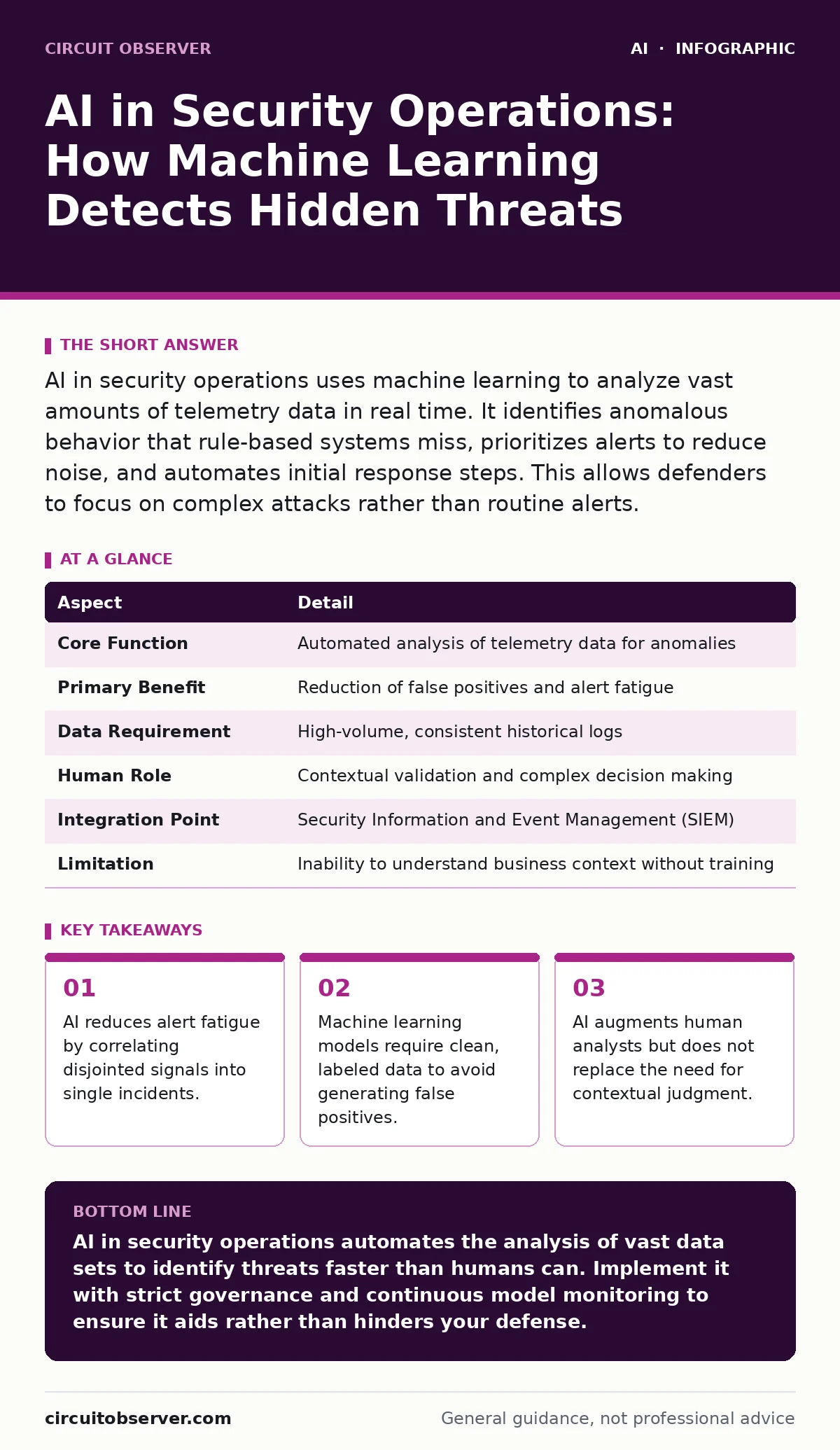
AI in security operations uses machine learning to analyze vast amounts of telemetry data in real time. It identifies anomalous behavior that rule-based systems miss, prioritizes alerts to reduce noise, and automates initial response steps. This allows defenders to focus on complex attacks rather than routine alerts.
The Signal Amidst The Noise
Imagine a librarian tasked with reading every book added to a library every hour, looking for a single sentence that predicts a fire. This is the daily reality for security teams. You cannot manually review millions of log entries from firewalls, endpoints, and cloud services. The volume exceeds human capacity.
AI in security operations acts as an automated filter. It ingests this massive stream of data and identifies patterns that deviate from the norm. It does not guess; it calculates probability based on historical behavior. This shifts the workflow from manual triage to focused investigation.
| Aspect | Detail |
|---|---|
| Core Function | Automated analysis of telemetry data for anomalies |
| Primary Benefit | Reduction of false positives and alert fatigue |
| Data Requirement | High-volume, consistent historical logs |
| Human Role | Contextual validation and complex decision making |
| Integration Point | Security Information and Event Management (SIEM) |
| Limitation | Inability to understand business context without training |
Defining the Mechanism
AI in security operations refers to the application of machine learning algorithms to defensive tasks. Machine learning is a subset of artificial intelligence where systems improve their performance through experience with data, rather than explicit programming for every scenario. In this context, the "experience" is the historical record of what normal network traffic and user behavior look like.
The purpose is detection and response. Traditional tools use static rules, such as "block traffic from this IP address." AI uses dynamic baselines. It learns that a specific user usually logs in from New York at 9 AM. If that same user logs in from London at 3 AM, the system flags it as anomalous, even if the login credentials are correct. This catches compromised accounts before they cause damage.
Solving the Scale Problem
The fundamental problem AI solves is scale. Modern infrastructure generates terabytes of data daily. A human analyst might review a few hundred alerts per day. An AI system reviews millions in seconds. This speed allows for real-time containment.
Consider the difference between finding a needle in a haystack and finding a needle in a stack of needles. Most security alerts are the stack—noise generated by benign activity that triggers a rule. AI distinguishes the true threat from the noise. It correlates events across different systems. A failed login attempt is common. A failed login followed by rapid file access and data exfiltration is a pattern. AI connects these dots automatically.
Where AI Fits in Defense
AI does not operate in isolation. It sits within a broader defense architecture. It typically interfaces with Security Information and Event Management (SIEM) systems, which collect logs, and Security Orchestration, Automation, and Response (SOAR) platforms, which execute actions. The AI provides the intelligence; the SOAR provides the muscle.
This integration is vital for automation. When AI identifies a high-confidence threat, it can trigger a playbook. The playbook might isolate the infected endpoint or disable the compromised user account. This happens in milliseconds, far faster than any human could react. However, the AI must be calibrated. Overly aggressive automation can lock out legitimate users, causing business disruption.
The Hidden Costs of Intelligence
There is a non-obvious cost to using AI: the burden of data quality. Machine learning models are only as good as the data they are trained on. If your logs are incomplete, inconsistent, or noisy, the AI will learn incorrect patterns. This leads to high false positive rates, where the system flags benign activity as malicious.
Another hidden cost is the maintenance of the model itself. Models drift over time. What was normal last year may be normal today due to business changes. You must continuously retrain the model with new data. This requires dedicated resources. It is not a "set and forget" solution. Neglecting this maintenance leads to degraded performance and missed threats.
See also: AI Governance Best Practices: Secure Your Models
What People Usually Get Wrong
A common misconception is that AI replaces human analysts. It does not. AI handles the repetitive, high-volume tasks. Humans handle the complex, ambiguous ones. An AI might flag an anomaly, but it cannot determine if that anomaly is a security researcher testing the system or an actual attacker. That requires context and judgment.
Another error is over-reliance on automation. If you trust the AI blindly, you lose the ability to verify its findings. You must maintain human oversight. The AI is a tool, not a decision-maker. It provides recommendations; you provide the final approval for critical actions. This balance ensures that automation aids efficiency without compromising safety.
Integrating With Governance
Deploying AI requires clear boundaries. You must define what data the AI can access and how it can act. This falls under AI governance. Without governance, an AI system might inadvertently access sensitive personal data or take actions that violate compliance requirements.
Furthermore, you must monitor the AI itself. AI model monitoring ensures that the system continues to perform as expected. If the model’s confidence scores drop or its error rate rises, you need to know immediately. This prevents silent failures where the AI stops detecting threats but continues to operate, giving a false sense of security.
The Future of Human-AI Teaming
The goal is not to eliminate humans from the loop but to elevate their work. By automating the mundane, you free your team to focus on hunting for advanced threats and improving defenses. This collaboration creates a more resilient security posture.
As attackers begin to use AI for their own purposes, such as creating AI-generated phishing emails that are harder to detect, your defensive AI must evolve. It becomes an arms race of algorithms. Staying ahead requires continuous learning and adaptation, both for your systems and your team.
Key takeaways
- AI reduces alert fatigue by correlating disjointed signals into single incidents.
- Machine learning models require clean, labeled data to avoid generating false positives.
- AI augments human analysts but does not replace the need for contextual judgment.
AI in security operations automates the analysis of vast data sets to identify threats faster than humans can. Implement it with strict governance and continuous model monitoring to ensure it aids rather than hinders your defense.
Frequently asked questions
Can AI detect zero-day vulnerabilities?
AI can identify anomalous behavior associated with zero-day exploits, but it cannot predict the vulnerability itself. It detects the effect, not the cause, based on statistical deviations from normal activity.
How much data is needed to train a security AI model?
There is no fixed amount, but generally, more data improves accuracy. However, data quality is more important than quantity. Clean, labeled data from a representative period is required to establish a reliable baseline.
Does AI replace the need for security rules?
No. AI complements rules. Rules are deterministic and good for known threats. AI is probabilistic and good for unknown or complex threats. Using both provides layered defense.
What is the risk of using AI in security?
The main risks are false positives, which waste analyst time, and model drift, which reduces accuracy over time. There is also the risk of adversarial attacks where attackers manipulate data to evade detection.
How this guide was produced: written by the Circuit Observer editorial team with AI assistance, checked against the public references listed below, and reviewed when the facts change. See our editorial policy or report an error.