
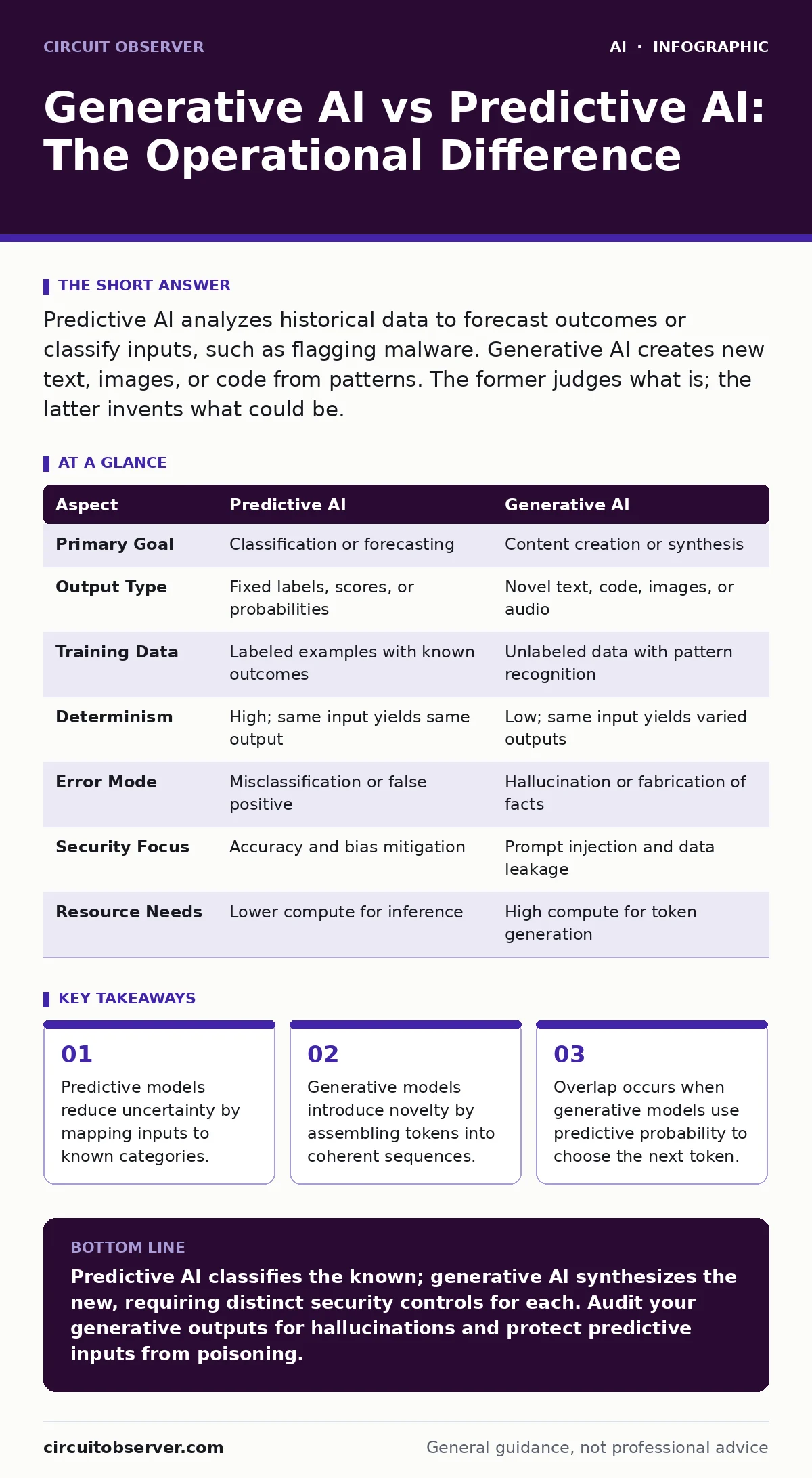
Predictive AI analyzes historical data to forecast outcomes or classify inputs, such as flagging malware. Generative AI creates new text, images, or code from patterns. The former judges what is; the latter invents what could be.
The Core Distinction in Output
The fundamental difference lies in the direction of data flow. Predictive AI takes an input and maps it to a predefined output space, such as a label, a score, or a probability. It answers questions about the present or near future based on past patterns. Generative AI takes an input and constructs a new output that did not exist in the training data. It answers open-ended prompts by synthesizing novel combinations of words, pixels, or bytes.
Imagine you have a dataset of every email ever sent. Predictive AI reads a new email and tells you if it is spam. Generative AI reads your draft and writes the reply for you. One classifies; the other creates. This distinction dictates how you secure, monitor, and deploy these systems in your infrastructure.
How Predictive Models Function
Predictive models rely on supervised learning, where the system is trained on labeled examples. The algorithm learns the boundaries between classes, such as "malicious" and "benign." When new data arrives, the model calculates which side of the boundary it falls on.
This approach is deterministic in its intent. You know the possible outputs because you defined them during training. If the model predicts "fraud," it is selecting from a finite set of possibilities. This makes it easier to audit and explain, as you can trace the decision back to specific features in the input data. However, it fails when faced with novel threats that do not resemble the training data.
How Generative Models Function
Generative models, such as large language models, operate through autoregressive prediction. They predict the next token in a sequence based on the previous ones. While this sounds predictive, the goal is not to classify the input but to extend it. The model chooses the most statistically likely next word, then the next, creating a chain of new content.
This process introduces stochasticity, or randomness, into the output. Two identical prompts can yield different responses because the model samples from a probability distribution rather than selecting a single fixed answer. This capability allows for creativity and flexibility but creates significant challenges for verification. You cannot easily predict what the model will say, only what it might say.
Side-by-Side Comparison
| Aspect | Predictive AI | Generative AI |
|---|---|---|
| Primary Goal | Classification or forecasting | Content creation or synthesis |
| Output Type | Fixed labels, scores, or probabilities | Novel text, code, images, or audio |
| Training Data | Labeled examples with known outcomes | Unlabeled data with pattern recognition |
| Determinism | High; same input yields same output | Low; same input yields varied outputs |
| Error Mode | Misclassification or false positive | Hallucination or fabrication of facts |
| Security Focus | Accuracy and bias mitigation | Prompt injection and data leakage |
| Resource Needs | Lower compute for inference | High compute for token generation |
Choosing the Right Approach
You must align the model type with the operational requirement. Using the wrong tool introduces unnecessary risk and cost.
Choose Predictive AI when:
- You need to sort large volumes of data into known categories.
- The cost of a false positive is manageable and defined.
- You require consistent, reproducible results for compliance.
- The problem space is closed, with a finite set of outcomes.
Choose Generative AI when:
- You need to draft content, code, or summaries from scratch.
- The task requires understanding context and nuance beyond simple keywords.
- You are building interfaces that require natural language interaction.
- You can implement LLM guardrails to catch factual errors before they reach the user.
See also: Injection attacks examples: how prompt leaks break AI systems · AI Agent Hijacking Response: Containment and Recovery Steps
The Overlap and Hybrid Systems
The line blurs when generative models use predictive techniques internally. Every step in generating text is a prediction of the next token. Conversely, predictive models can use generative techniques to augment training data, creating synthetic examples to improve accuracy.
In security operations, this overlap is critical. Adversarial examples designed to fool predictive classifiers can sometimes be generated by generative models. Understanding this interplay helps you design AI security testing protocols that stress both the classifier and the generator. A system that generates test cases for a firewall is using generative AI to improve predictive security.
Security Implications for Infrastructure
The attack surfaces differ significantly. Predictive models are vulnerable to data poisoning, where attackers inject malicious samples into the training set to skew future classifications. Generative models are vulnerable to prompt injection, where users manipulate the input to bypass safety filters or extract sensitive data.
Consider sensitive data leaks through AI chatbots. In a predictive system, the risk is usually limited to the input data being logged. In a generative system, the model might regurgitate memorized training data if not properly constrained. This requires different monitoring strategies. For predictive models, monitor drift in accuracy. For generative models, monitor output for policy violations and unexpected data disclosure.
Operational Trade-offs
Deploying generative AI increases complexity. You must manage context windows, token limits, and latency. Predictive models are generally faster and cheaper to run at scale. However, generative models can handle unstructured data with greater flexibility, reducing the need for rigid data preprocessing pipelines.
The hidden cost of generative AI is the difficulty of validation. You cannot simply check if the output is "correct" because there is no single correct answer. You must build evaluation frameworks that assess relevance, tone, and factual accuracy. This often requires integrating deepfake detection mechanisms if the model generates media, or using AI-generated phishing simulators to test employee awareness against realistic threats.
Addressing Emergent Risks
New risks emerge as these technologies mature. Jailbreaking AI chatbots is a technique where users craft complex prompts to bypass safety restrictions. This is a generative-specific threat that does not apply to traditional predictive classifiers. Similarly, shadow AI occurs when employees use unauthorized generative tools, bypassing organizational controls and potentially exposing proprietary information.
To mitigate these risks, enforce strict input validation and output filtering. Treat generative AI outputs as untrusted data until verified. Implement logging that captures both the prompt and the response for audit purposes. This allows you to reconstruct incidents and refine your security controls over time.
Key takeaways
- Predictive models reduce uncertainty by mapping inputs to known categories.
- Generative models introduce novelty by assembling tokens into coherent sequences.
- Overlap occurs when generative models use predictive probability to choose the next token.
Predictive AI classifies the known; generative AI synthesizes the new, requiring distinct security controls for each. Audit your generative outputs for hallucinations and protect predictive inputs from poisoning.
Frequently asked questions
Can predictive AI generate new data?
No, predictive AI assigns labels or scores to existing data. It does not create new content, though it can identify patterns that humans might use to create data.
Is generative AI just a fancy predictive model?
Technically, it predicts the next token, but its purpose is synthesis. The cumulative effect of many predictions creates novel output, unlike a single classification decision.
Which is harder to secure?
Generative AI is generally harder to secure due to its open-ended nature and susceptibility to prompt injection. Predictive AI has a narrower, more defined attack surface.
Do I need both types of AI?
Often, yes. Use predictive AI to filter and route data, then use generative AI to process the approved data for detailed analysis or content creation.
How this guide was produced: written by the Circuit Observer editorial team with AI assistance, checked against the public references listed below, and reviewed when the facts change. See our editorial policy or report an error.