
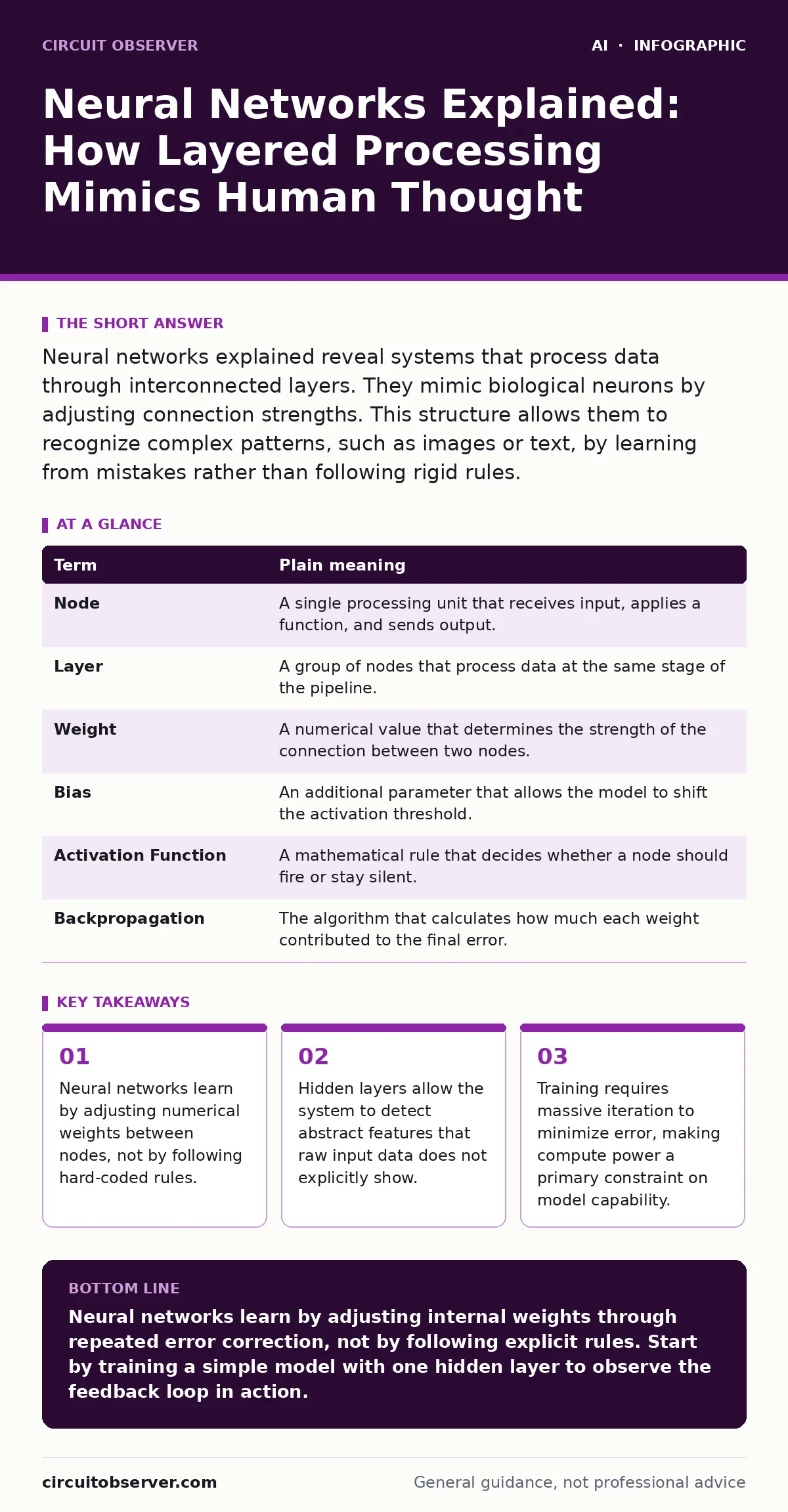
Neural networks explained reveal systems that process data through interconnected layers. They mimic biological neurons by adjusting connection strengths. This structure allows them to recognize complex patterns, such as images or text, by learning from mistakes rather than following rigid rules.
Neural Networks Explained: The Core Mechanism
Neural networks explained rely on a structure that mirrors biological brain function but operates through pure mathematics. Imagine a large factory assembly line where each worker passes a part to the next. Each worker adjusts the part slightly based on feedback from the final quality check. If the final product is flawed, the factory sends a signal backward. Every worker tweaks their adjustment method to reduce the error next time. This backward signal flow is the foundation of how these systems learn.
The system starts with random adjustments. It processes input data through multiple stages. Each stage transforms the data slightly. The final output is compared to the known correct answer. The difference between the predicted output and the actual answer is calculated. This difference drives the adjustment of internal parameters. The process repeats thousands or millions of times. Over time, the adjustments converge on a pattern that produces accurate results. This is not magic. It is iterative optimization.
The Assembly Line Analogy in Detail
To understand the architecture, keep the factory analogy active. The raw materials entering the factory represent your input data. This could be pixel values from an image or words from a document. The first row of workers performs simple checks. They might identify edges in an image or common words in text. They pass these basic features to the next row.
The middle rows perform more complex transformations. They combine simple edges into shapes. They combine common words into phrases. These middle workers operate in the dark. You do not see their individual decisions. You only see the final product. This opacity is a defining characteristic of deep learning systems. The final row makes the decision. It declares whether the image contains a cat or the text expresses anger. If the declaration is wrong, the error signal travels back through every row.
Key Terms in Neural Network Architecture
Understanding the vocabulary helps you navigate technical discussions. The terms below define the components of the system.
| Term | Plain meaning |
|---|---|
| Node | A single processing unit that receives input, applies a function, and sends output. |
| Layer | A group of nodes that process data at the same stage of the pipeline. |
| Weight | A numerical value that determines the strength of the connection between two nodes. |
| Bias | An additional parameter that allows the model to shift the activation threshold. |
| Activation Function | A mathematical rule that decides whether a node should fire or stay silent. |
| Backpropagation | The algorithm that calculates how much each weight contributed to the final error. |
Why Hidden Layers Matter
The power of these networks comes from the hidden layers. These are the layers between the input and the output. They extract features that are not obvious in the raw data. In our factory analogy, the hidden layers are where raw wood becomes a shaped chair leg. You do not see the wood anymore. You see a component.
Without hidden layers, the system can only learn linear relationships. It cannot distinguish between complex patterns. A single layer can tell if a line is red or blue. It cannot tell if a red line forms the letter O or the number 0. Multiple layers allow the system to build hierarchy. The first layer detects curves. The second layer detects loops. The third layer recognizes characters. This hierarchical feature extraction is what enables modern AI capabilities.
See our guide on large language models to understand how this layering applies specifically to text processing and semantic understanding.
The Cost of Training
Training a neural network is computationally expensive. Each iteration requires calculating gradients for every weight in the system. If the system has millions of weights, this calculation is massive. You must balance the number of layers with the available compute power. Too many layers lead to overfitting. The system memorizes the training data instead of learning general patterns. It fails on new, unseen data.
Too few layers lead to underfitting. The system is too simple to capture the complexity of the data. It performs poorly on both training and new data. Finding the right architecture requires experimentation. You must monitor the error rate on a separate validation set. This set is never used during training. It provides an honest measure of generalization.
See also: Fine-Tuning vs RAG: Which AI Architecture Fits Your Data
A First Practical Step for Implementation
You do not need to build a network from scratch to understand it. Start by using a pre-built library. These libraries handle the complex mathematics of backpropagation. You focus on the data and the architecture.
- Prepare a clean dataset. Ensure your labels are consistent and your data is normalized.
- Define a simple architecture. Start with one hidden layer. Use a standard activation function like ReLU.
- Train the model. Monitor the loss function. Stop training when the validation error stops decreasing.
This process teaches you the feedback loop. You see how changing the number of layers affects performance. You see how learning rate impacts convergence. This hands-on experience grounds the theoretical concepts.
Explore AI in security operations to see how these trained models detect anomalies in network traffic without explicit rules.
Limitations and Security Risks
Neural networks are not infallible. They can be fooled by adversarial examples. Small, imperceptible changes to input data can cause massive errors in output. In our factory analogy, this is like adding a speck of dust that causes the final inspector to reject a perfect chair. The system lacks common sense. It relies entirely on statistical correlations.
This vulnerability requires specific defenses. You must test your models against adversarial inputs. You must implement input validation. You must monitor for drift in the input data distribution. If the real-world data changes, the model’s accuracy degrades. This is known as concept drift.
Read about prompt injection attacks to understand how attackers manipulate input data to bypass safety filters in language models.
Conclusion of the Mechanism
Neural networks explained are systems of iterative error correction. They transform raw data into decisions through layered processing. The hidden layers extract abstract features. The backpropagation algorithm adjusts weights to minimize error. This mechanism allows them to solve problems that rule-based systems cannot.
The trade-off is transparency. You cannot easily inspect the logic inside the hidden layers. You must trust the validation metrics. You must guard against overfitting and adversarial attacks. Understanding these constraints is as important as understanding the architecture.
See our guide on LLM guardrails to learn how to constrain model output and prevent harmful generation.
Key takeaways
- Neural networks learn by adjusting numerical weights between nodes, not by following hard-coded rules.
- Hidden layers allow the system to detect abstract features that raw input data does not explicitly show.
- Training requires massive iteration to minimize error, making compute power a primary constraint on model capability.
Neural networks learn by adjusting internal weights through repeated error correction, not by following explicit rules. Start by training a simple model with one hidden layer to observe the feedback loop in action.
Frequently asked questions
How do neural networks differ from traditional programming?
Traditional programming uses explicit rules written by humans. Neural networks learn rules from data by adjusting internal parameters through trial and error.
Can neural networks explain their decisions?
Not easily. The internal weights represent complex mathematical relationships that are difficult for humans to interpret, leading to the "black box" problem.
What is overfitting in neural networks?
Overfitting occurs when a model memorizes the training data instead of learning general patterns, causing it to perform poorly on new, unseen data.
Why are hidden layers necessary?
Hidden layers allow the network to learn hierarchical features, transforming simple inputs into complex representations that enable accurate classification and prediction.
How this guide was produced: written by the Circuit Observer editorial team with AI assistance, checked against the public references listed below, and reviewed when the facts change. See our editorial policy or report an error.