
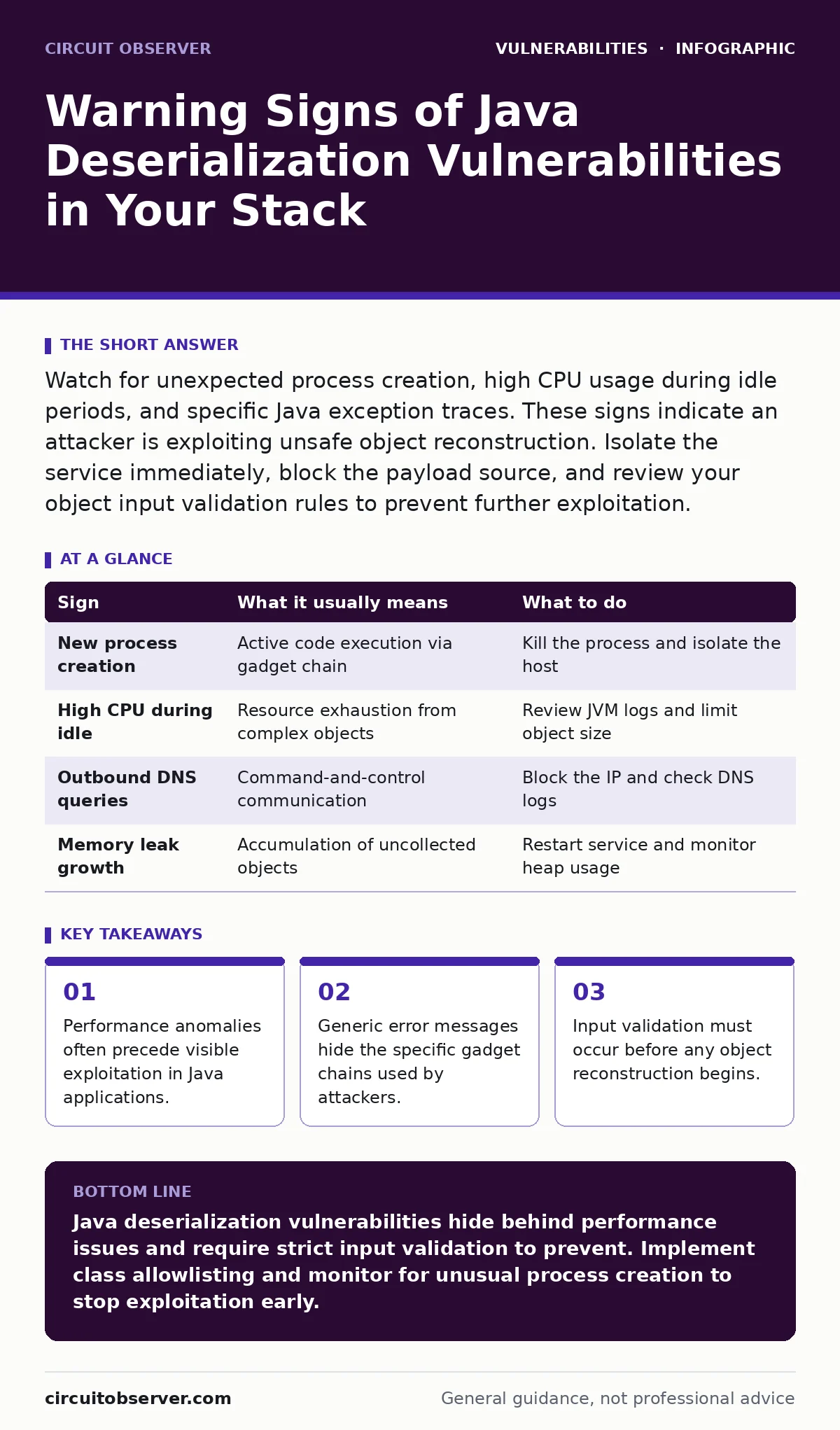
Watch for unexpected process creation, high CPU usage during idle periods, and specific Java exception traces. These signs indicate an attacker is exploiting unsafe object reconstruction. Isolate the service immediately, block the payload source, and review your object input validation rules to prevent further exploitation.
Obvious Symptoms of Active Exploitation
Java deserialization vulnerabilities manifest when an application reconstructs objects from untrusted data streams without proper validation. You will notice these signs first when the exploitation is active and noisy. The system behaves erratically because the deserialized object executes code during its reconstruction phase. This behavior bypasses normal application logic and directly impacts the runtime environment.
Process creation is the most visible indicator. Suppose your web server suddenly spawns a reverse shell or a command interpreter. This happens when an attacker uses a gadget chain to execute system commands. You see new processes in your task manager that do not belong to the application stack. These processes often have strange parent-child relationships or run under the application user account.
Network connections appear without justification. The application initiates outbound connections to unknown IP addresses or ports. This traffic often looks like DNS queries or HTTP requests to external command-and-control servers. You may notice these connections in your firewall logs or network monitoring tools. The traffic patterns do not match normal application behavior or expected user requests.
Subtle Signs That Are Easy to Miss
Early-stage exploitation often leaves no visible processes or network connections. Attackers may probe for vulnerabilities using benign payloads to confirm the flaw exists. You must look for performance degradation or resource exhaustion to catch these silent attempts. These signs are easy to miss because they resemble standard application stress or configuration errors.
CPU spikes during idle periods signal deserialization overhead. Reconstructing complex object graphs consumes significant processing power. If your application server shows high CPU usage while serving few requests, an attacker may be feeding it large, nested objects. This happens because the JVM works hard to allocate memory and execute initialization code for every object in the chain.
Memory leaks grow slowly over time. Deserialized objects that are not properly garbage collected accumulate in the heap. You observe gradual memory increase that does not correlate with user traffic. Eventually, the application crashes with out-of-memory errors. This crash is the result of sustained, low-volume exploitation that drains available resources until the service fails completely.
Understanding the Underlying Mechanism
Java deserialization works by converting a byte stream back into a Java object. The vulnerability exists when the application trusts this stream without verifying its contents. The attacker crafts a specific byte sequence that, when deserialized, triggers unintended code execution. This execution happens during the object's initialization, before the application can check its validity.
Gadget chains are the core of the attack. These are sequences of existing library classes that, when combined, perform harmful actions. Attackers chain together methods from trusted libraries to achieve arbitrary code execution. The danger lies in the fact that these libraries are usually safe and necessary for application functionality. The combination creates a path to system compromise that developers rarely anticipate.
Serialization is not just data transfer. It preserves object state, including references to other objects and internal variables. When an attacker controls the serialized data, they control the object state. This allows them to inject malicious references or trigger methods that were never intended to be called from outside the application. The mechanism bypasses access controls because the code runs as part of the object construction process.
Immediate Response Steps
Isolate the affected service immediately upon detecting signs of deserialization exploitation. Stop the application process to prevent further code execution. Do not simply restart the service, as this may preserve the attacker's foothold or allow re-exploitation. Preserve logs and memory dumps for forensic analysis before shutting down completely.
Block the source IP address at the firewall level. This stops the immediate attack traffic but does not fix the underlying vulnerability. Identify the specific endpoint or API that accepted the malicious payload. Check access logs for similar requests from other IP addresses to determine the scope of the compromise.
Review your object input validation rules. Ensure that the application rejects any serialized data that does not match a strict whitelist of allowed classes. Implement allowlisting before the deserialization step occurs. This prevents the JVM from processing malicious objects in the first place. Refer to least privilege access principles to limit what the application user can do if exploitation occurs.
Detecting Hidden Gadget Chains
Standard logging often misses the internal mechanics of deserialization attacks. You need to enable detailed JVM logging to see object reconstruction events. Look for class loading events that occur unexpectedly during request processing. These events indicate that the application is loading classes that should not be instantiated from user input.
Static analysis tools can identify vulnerable code paths. Scan your source code for deserialization methods that accept untrusted input. Check for libraries known to contain gadget chains. Many popular libraries have known vulnerabilities that attackers exploit. Keep your dependencies updated to patch these known chains. Refer to malicious typosquatted packages to understand how attackers distribute these vulnerable libraries.
Runtime monitoring helps catch exploitation in progress. Tools that monitor method calls can detect unusual sequences of invocations. Look for calls to system command execution methods or file operations that originate from deserialized objects. These calls are the final step in the gadget chain. Detecting them allows you to stop the attack before it completes.
Preventing Future Exploitation
Implement strict class allowlisting for all deserialization operations. Define exactly which classes can be deserialized and reject everything else. This approach is more secure than blocklisting, which attackers can bypass by finding new gadget chains. Configure the Java ObjectInputStream to use a custom filter that enforces these rules.
Use safe data formats instead of Java serialization. JSON and XML are safer alternatives for data exchange. These formats do not execute code during parsing. They separate data from code, making it harder for attackers to inject malicious instructions. If you must use Java serialization, ensure it is only used for trusted internal communication, not for external user input.
Regularly audit your third-party dependencies. New gadget chains are discovered frequently in popular libraries. Update your libraries to versions that patch these vulnerabilities. Use software composition analysis to track your dependencies. Refer to file upload vulnerabilities to understand how attackers might bypass input filters and deliver malicious payloads.
| Sign | What it usually means | What to do |
|---|---|---|
| New process creation | Active code execution via gadget chain | Kill the process and isolate the host |
| High CPU during idle | Resource exhaustion from complex objects | Review JVM logs and limit object size |
| Outbound DNS queries | Command-and-control communication | Block the IP and check DNS logs |
| Memory leak growth | Accumulation of uncollected objects | Restart service and monitor heap usage |
Long-Term Security Hygiene
Adopt runtime application self-protection (RASP) to detect exploitation in real-time. RASP monitors the application runtime and blocks malicious behavior. It can stop gadget chain execution before it completes. This adds a layer of defense that complements static code analysis and input validation.
Train developers on safe deserialization practices. Ensure they understand the risks of trusting external data. Encourage the use of safe data formats and strict validation. Regular code reviews should focus on deserialization endpoints. Refer to web cache poisoning to understand how attackers might manipulate cached responses to deliver malicious payloads.
Conduct regular penetration testing. Simulate deserialization attacks to test your defenses. Verify that allowlisting rules are enforced correctly. Check that logging captures all relevant events. This proactive approach helps identify weaknesses before attackers exploit them. Refer to open redirect vulnerabilities to see how other input flaws can complement deserialization attacks.
Key takeaways
- Performance anomalies often precede visible exploitation in Java applications.
- Generic error messages hide the specific gadget chains used by attackers.
- Input validation must occur before any object reconstruction begins.
Java deserialization vulnerabilities hide behind performance issues and require strict input validation to prevent. Implement class allowlisting and monitor for unusual process creation to stop exploitation early.
Frequently asked questions
How do I know if my Java app is vulnerable to deserialization?
Check if your application deserializes data from untrusted sources without validating the class names. Look for ObjectInputStream usage in API endpoints.
Can a firewall stop Java deserialization attacks?
A firewall can block known malicious IPs but cannot inspect the serialized data payload. You need application-level filtering to stop the attack.
Is JSON safer than Java serialization?
Yes, JSON does not execute code during parsing. It separates data from logic, making it much harder to inject malicious instructions.
What is a gadget chain in Java deserialization?
A gadget chain is a sequence of library classes that, when deserialized together, trigger unintended code execution. Attackers use them to bypass security controls.
How this guide was produced: written by the Circuit Observer editorial team with AI assistance, checked against the public references listed below, and reviewed when the facts change. See our editorial policy or report an error.