
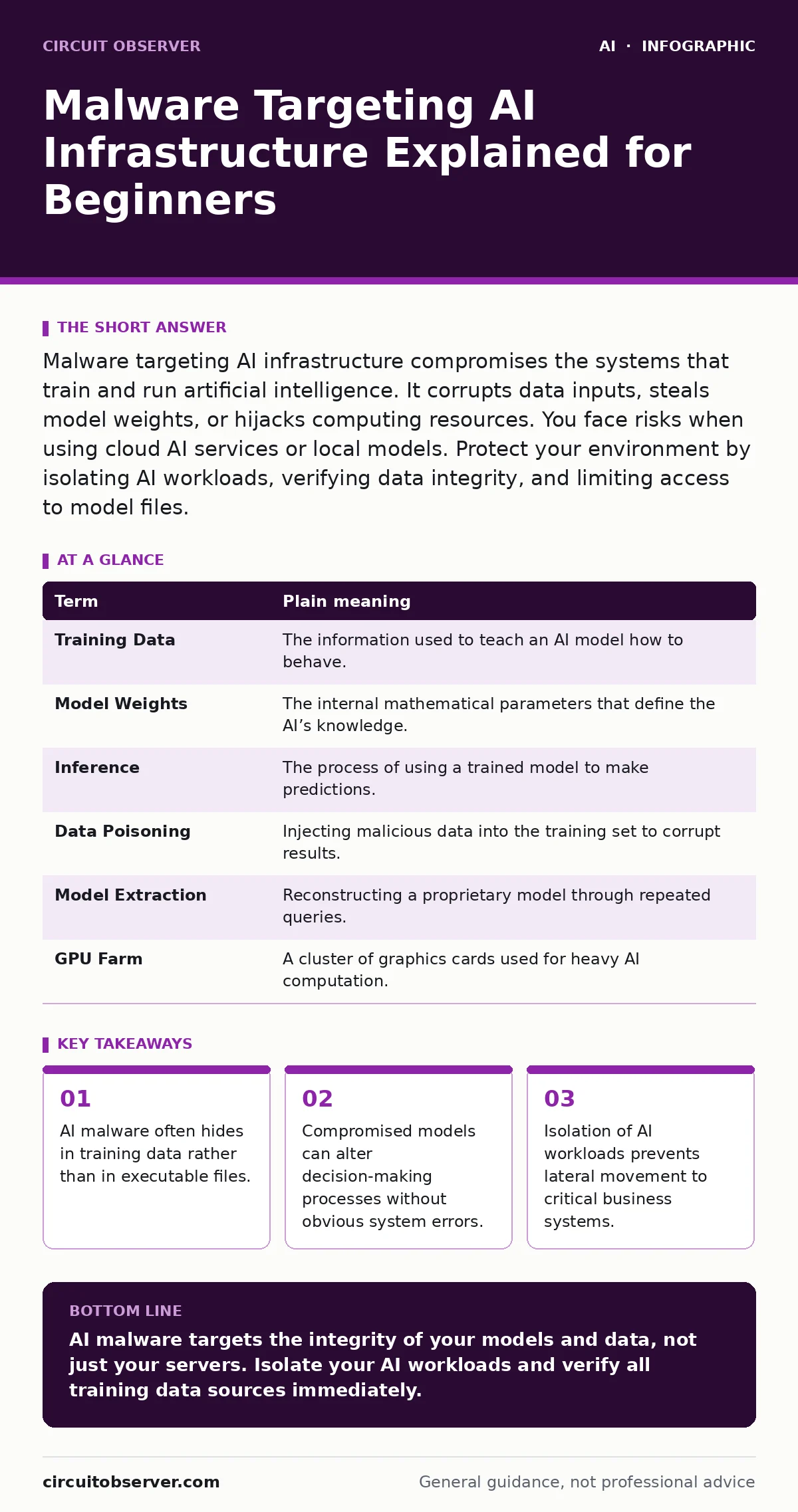
Malware targeting AI infrastructure compromises the systems that train and run artificial intelligence. It corrupts data inputs, steals model weights, or hijacks computing resources. You face risks when using cloud AI services or local models. Protect your environment by isolating AI workloads, verifying data integrity, and limiting access to model files.
The Library Analogy for AI Security
Imagine a massive library where librarians write encyclopedias. The librarians represent your AI models. The books they read are your training data. The encyclopedia is the final output you use. Traditional malware is like a thief stealing books. AI-specific malware is different. It slips false facts into the books. The librarians read these lies and write them into the encyclopedia. Users trust the encyclopedia. They act on false information. The theft is invisible until the damage is done.
This analogy holds throughout the guide. When we discuss data poisoning, we mean inserting bad books. When we discuss model theft, we mean stealing the librarian’s notes. When we discuss resource hijacking, we mean forcing the library to stay open all night for no reason. Understanding this structure helps you see where the vulnerabilities lie.
Key Terms Defined
You need to know the specific parts of the AI system that attackers target. These terms appear in security alerts and technical discussions. Knowing them helps you communicate risks clearly.
| Term | Plain meaning |
|---|---|
| Training Data | The information used to teach an AI model how to behave. |
| Model Weights | The internal mathematical parameters that define the AI’s knowledge. |
| Inference | The process of using a trained model to make predictions. |
| Data Poisoning | Injecting malicious data into the training set to corrupt results. |
| Model Extraction | Reconstructing a proprietary model through repeated queries. |
| GPU Farm | A cluster of graphics cards used for heavy AI computation. |
How Attackers Corrupt the Supply Chain
Attackers rarely break into the final AI application directly. They target the supply chain. They inject malicious code or data into the libraries and frameworks you use. This is similar to the shadow AI problem where unvetted tools enter your environment. If a dependency has a flaw, your model inherits it.
Data poisoning is a common tactic. An attacker adds subtle errors to your training data. The model learns these errors as facts. This creates a blind spot. The model behaves normally on clean data but fails on specific triggers. This is a non-obvious consequence. You see no system crash. You see no error logs. You only see wrong decisions. This makes detection very difficult.
The Risk of Model Theft
Your AI model is intellectual property. It represents years of work and unique data. Attackers can steal this model through AI model theft. They do not need to break into your server. They can query the model repeatedly. By analyzing the inputs and outputs, they can reconstruct the model. This is called model extraction.
This is a hidden cost many organizations ignore. You think your model is safe behind a firewall. It is not. Every query leaks information. An attacker can build a twin of your model. They can use it to bypass your security checks. They can replicate your service. You lose your competitive advantage. You also risk liability if the stolen model causes harm elsewhere.
What This Means for Ordinary Users
You might think this only affects large tech companies. It affects anyone using AI tools. If you use large language models for customer support, a compromised model can give harmful advice. If you use AI for filtering emails, a poisoned model can let through AI-generated phishing attempts.
The risk is not just data loss. It is trust loss. If your AI gives wrong answers, users stop trusting it. They stop using your service. This reputational damage is hard to repair. You must assume that any AI system you deploy can be targeted. You must plan for compromise. You must have a way to revert to a known good state.
See also: Large Language Models as Optimizers: Why Your Code Changes Break · Injection attacks examples: how prompt leaks break AI systems
Simple Safety Habits for AI Systems
You do not need a massive security team to start. You need disciplined habits. These habits reduce the attack surface. They make it harder for attackers to succeed.
- Isolate AI workloads from other systems. Run AI models in separate containers or virtual machines. This limits the damage if a model is compromised. It prevents lateral movement to your main database.
- Verify all training data. Check the source of every data point. Look for anomalies. Use checksums to ensure data has not been altered. This prevents data poisoning.
- Limit model access. Restrict who can query the model. Rate limit the number of queries. This slows down model extraction attacks. It gives you time to detect suspicious activity.
The Hidden Cost of Over-Reliance
Many organizations rely on AI for critical decisions. They forget that AI is just software. It can be tricked. It can be corrupted. This over-reliance creates a single point of failure. If the AI fails, the business fails.
This is where AI governance becomes critical. You need policies that define how AI is used. You need oversight for AI decisions. You need a human in the loop for high-stakes actions. This is not about slowing down innovation. It is about managing risk. It is about ensuring that when AI fails, it fails safely.
Integrating AI Into Your Defense
You can also use AI to fight AI. AI in security operations can detect anomalies faster than humans. It can spot patterns in data poisoning attempts. It can identify unusual query patterns that suggest model extraction.
However, this creates an arms race. Attackers will use AI to bypass your AI defenses. They will use AI agent hijacking to turn your own tools against you. You must stay ahead. You must continuously update your detection models. You must test them against new threats. This is a continuous process. It requires constant attention.
Key takeaways
- AI malware often hides in training data rather than in executable files.
- Compromised models can alter decision-making processes without obvious system errors.
- Isolation of AI workloads prevents lateral movement to critical business systems.
AI malware targets the integrity of your models and data, not just your servers. Isolate your AI workloads and verify all training data sources immediately.
Frequently asked questions
Can malware hide inside an AI model file?
Yes, attackers can embed malicious code or corrupted weights within the model file itself, which executes when the model is loaded.
How do I know if my AI model has been poisoned?
You typically do not see system errors. You must monitor for sudden changes in output accuracy or unexpected behavior on specific inputs.
Is using open-source AI models safe?
Open-source models can contain vulnerabilities or poisoned data. You must audit the source code and training data before deploying them.
Does encryption protect AI models from theft?
Encryption protects stored models, but it does not prevent extraction through repeated queries during active use.
How this guide was produced: written by the Circuit Observer editorial team with AI assistance, checked against the public references listed below, and reviewed when the facts change. See our editorial policy or report an error.