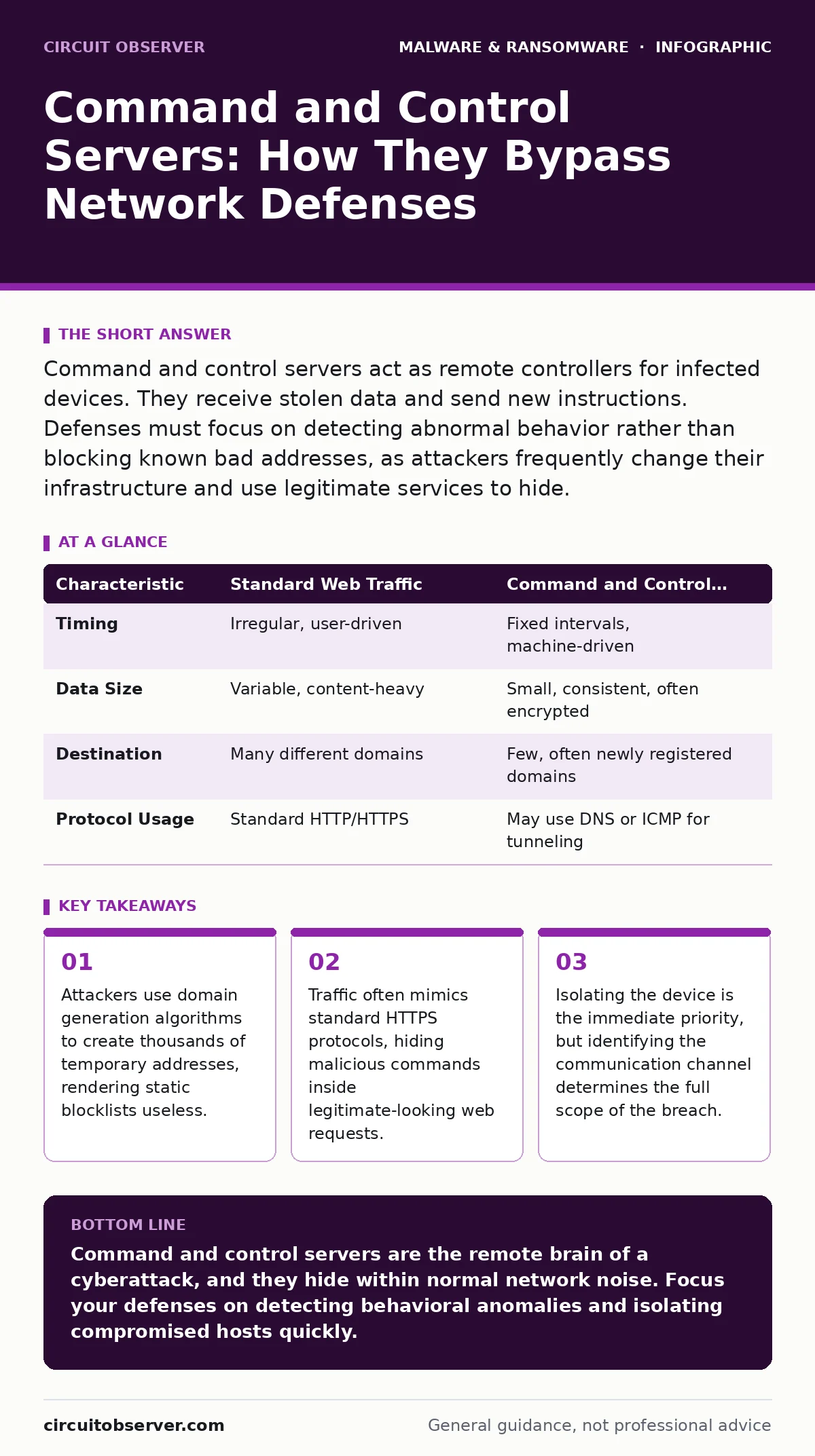
Command and control servers act as remote controllers for infected devices. They receive stolen data and send new instructions. Defenses must focus on detecting abnormal behavior rather than blocking known bad addresses, as attackers frequently change their infrastructure and use legitimate services to hide.
What is a command and control server?
A command and control server is a remote computer that an attacker uses to manage compromised devices. The infected machine, often called a bot, sends data to this server and receives instructions from it. This architecture allows the attacker to operate from a distance, hiding their true location while maintaining persistent access.
How do attackers hide these servers from defenders?
Attackers disguise their traffic by mimicking legitimate protocols like HTTP and DNS. They embed commands within standard web requests or use encrypted channels that look like normal browsing. Some even route traffic through popular cloud services or social media platforms. This technique, often discussed in guides on malware obfuscation, makes the malicious traffic indistinguishable from daily user activity.
Why do blocklists fail to stop this traffic?
Static lists of known malicious addresses become outdated quickly. Attackers use domain generation algorithms to create thousands of random domain names each day. They also employ fast-flux DNS, which rapidly changes the IP address associated with a single domain name. By the time a specific address is blocked, the attacker has already moved to a new one.
What is beaconing and why does it matter?
Beaconing is the regular, scheduled communication between the infected device and the server. Even when no new commands are sent, the bot checks in to confirm it is still active. This consistent timing and data size create a statistical anomaly. Security tools look for these repeating patterns to identify compromised hosts, a method central to behavior-based detection.
| Characteristic | Standard Web Traffic | Command and Control Traffic |
|---|---|---|
| Timing | Irregular, user-driven | Fixed intervals, machine-driven |
| Data Size | Variable, content-heavy | Small, consistent, often encrypted |
| Destination | Many different domains | Few, often newly registered domains |
| Protocol Usage | Standard HTTP/HTTPS | May use DNS or ICMP for tunneling |
Can legitimate services be abused for control?
Yes, attackers use living-off-the-land techniques to hide in plain sight. They may use GitHub, Twitter, or legitimate email services to transmit commands. The payload is hidden in the body of a tweet, a commit message, or an email attachment. Because these services are trusted, firewalls typically allow the traffic to pass. This is why dynamic malware analysis often requires isolating the network to see what external connections are attempted.
See also: List of Ports and Protocols: How to Map and Secure Your Network · OSI Model Acronym: What Each Layer Does for Your Network Security
How does encryption complicate detection?
Modern command and control channels use standard TLS encryption. This prevents defenders from inspecting the content of the communication. You can see that data is moving, but not what it says. Attackers often use self-signed certificates or domains with valid certificates to avoid triggering warnings. Without decryption keys, the only visible indicators are metadata like timing and volume.
What is the difference between a loader and the server?
The loader is the initial piece of software that installs the main malware on the device. The command and control server is the external infrastructure that directs the malware. The loader might be delivered via a phishing email, while the server resides in a different country. Understanding this separation helps in containment, as blocking the server does not remove the loader from the local machine. See malware droppers and loaders for more on initial delivery.
How do you respond when you find one?
Isolate the affected device from the network immediately. Do not power it off, as this destroys volatile memory evidence. Capture network logs and memory dumps before remediation. Identify the communication channel to see if other devices are connecting to the same server. This step is critical because malware payloads often spread laterally once the initial foothold is established.
What is domain fronting and why is it dangerous?
Domain fronting hides the true destination of traffic by using a legitimate domain as a proxy. The attacker makes a request to a popular service, but the underlying infrastructure routes it to the malicious server. This bypasses firewalls that only check the domain name in the URL. It is particularly effective against systems that do not inspect the full request path. This technique is often used alongside Linux malware to maintain persistent access on server infrastructure.
How do you protect against future compromises?
Implement strict network segmentation to limit lateral movement. Use application whitelisting to prevent unauthorized executables from running. Monitor outbound traffic for anomalies rather than just inbound threats. Regularly update systems to patch vulnerabilities that allow initial access. Ensure you have offline backups to restore systems without paying ransoms or rebuilding from compromised images.
Key takeaways
- Attackers use domain generation algorithms to create thousands of temporary addresses, rendering static blocklists useless.
- Traffic often mimics standard HTTPS protocols, hiding malicious commands inside legitimate-looking web requests.
- Isolating the device is the immediate priority, but identifying the communication channel determines the full scope of the breach.
Command and control servers are the remote brain of a cyberattack, and they hide within normal network noise. Focus your defenses on detecting behavioral anomalies and isolating compromised hosts quickly.
Frequently asked questions
Can I block command and control traffic with a simple firewall rule?
No, because this traffic often uses standard ports and protocols like HTTPS that are necessary for normal business operations. Blocking these broadly will disrupt legitimate services.
How long does it take to detect a command and control connection?
Detection time varies widely depending on the attacker's stealth techniques and your monitoring capabilities. Some connections persist for months before being identified.
Does antivirus software stop command and control servers?
Antivirus tools may detect the malware on the device, but they cannot block the remote server. You need network monitoring and endpoint detection to stop the communication.
What is the risk if I only block the IP address?
The attacker will simply generate a new domain or IP address. The malware remains on your device and will attempt to reconnect, often using different methods.
How this guide was produced: written by the Circuit Observer editorial team with AI assistance, checked against the public references listed below, and reviewed when the facts change. See our editorial policy or report an error.