
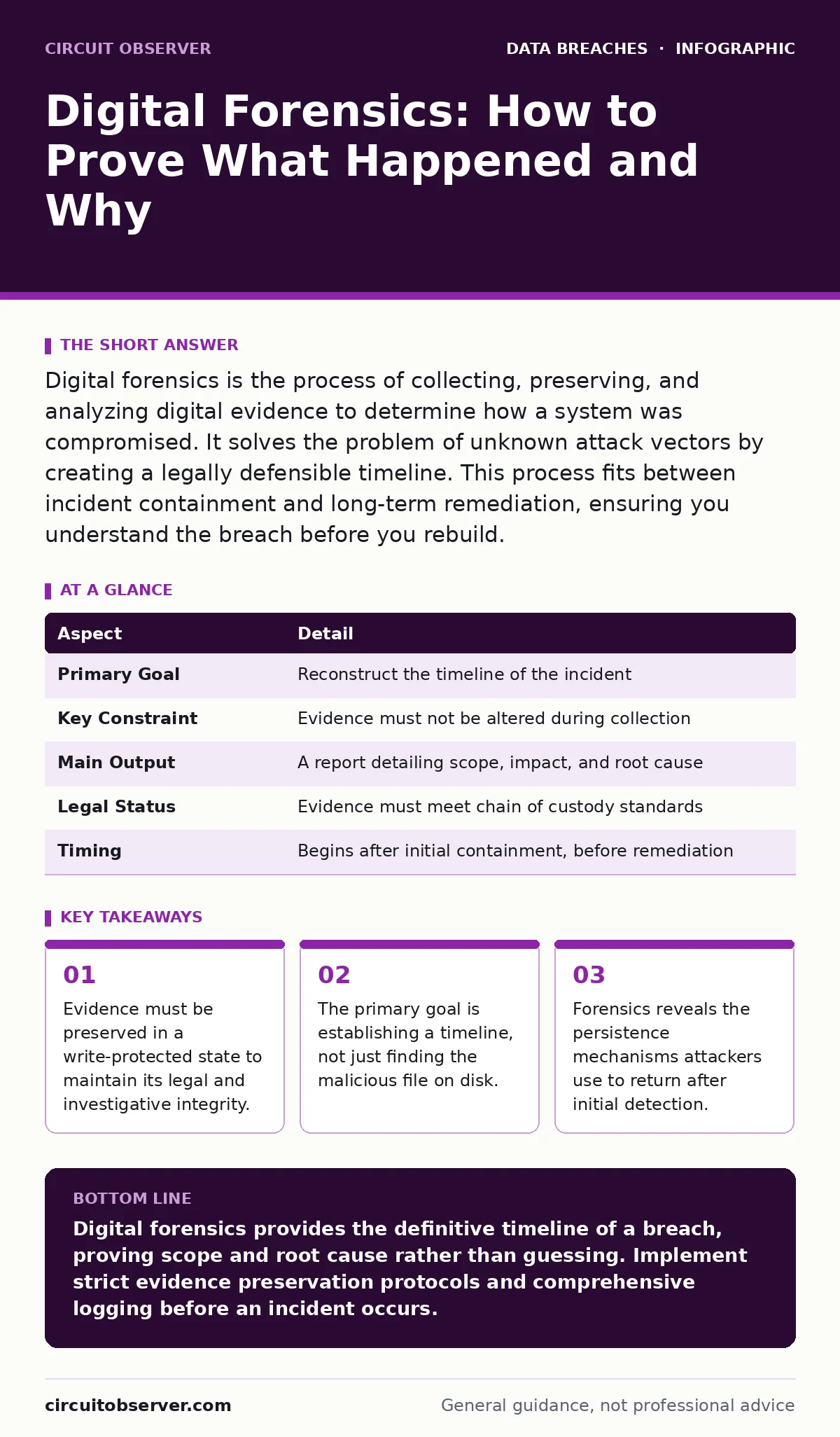
Digital forensics is the process of collecting, preserving, and analyzing digital evidence to determine how a system was compromised. It solves the problem of unknown attack vectors by creating a legally defensible timeline. This process fits between incident containment and long-term remediation, ensuring you understand the breach before you rebuild.
The Crime Scene in Bytes
Imagine finding a broken window in your office. You do not just tape it up and leave. You look for footprints, check if anything was taken, and determine if the intruder has a key. Digital forensics applies this same logic to your servers and endpoints. It is the systematic process of identifying, preserving, analyzing, and presenting digital evidence.
The core problem it solves is uncertainty. When a breach occurs, you know something is wrong, but you rarely know the full extent. Did the attacker only steal one file, or did they move laterally to the database? Did they leave a backdoor that allows them to return tomorrow? Without forensics, you are guessing. Guessing leads to incomplete cleanup and repeated breaches.
This discipline differs from standard troubleshooting. Troubleshooting aims to restore service quickly. Forensics aims to understand the event fully, often slowing down restoration to ensure no evidence is lost. You must balance operational pressure with the need for accurate historical data.
| Aspect | Detail |
|---|---|
| Primary Goal | Reconstruct the timeline of the incident |
| Key Constraint | Evidence must not be altered during collection |
| Main Output | A report detailing scope, impact, and root cause |
| Legal Status | Evidence must meet chain of custody standards |
| Timing | Begins after initial containment, before remediation |
Preserving the Volatile State
The first rule of digital forensics is that data changes the moment you look at it. Accessing a file updates its "last accessed" timestamp. Booting a server loads new processes into memory. If you do not handle this carefully, you destroy the very evidence you need.
You must prioritize volatile data. This is information that disappears when power is lost, such as RAM contents, running processes, and network connections. Think of RAM as a whiteboard that gets wiped clean when you turn off the lights. You need to photograph that whiteboard before you flip the switch.
Standard procedure involves creating a bit-for-bit copy of the storage media. This is called a forensic image. You analyze the image, never the original drive. This ensures that if your analysis is challenged in court or by an insurance carrier, you can prove the original data was never touched.
The Chain of Custody
Technical accuracy means nothing if you cannot prove who handled the evidence. Chain of custody is the documented history of every person who touched the digital evidence, from collection to disposal. It includes who collected it, when, where it was stored, and who analyzed it.
If a gap exists in this record, the evidence may be inadmissible in legal proceedings. It also undermines internal trust. If the CEO asks how you know the breach started three weeks ago, you must point to a log entry, not a hunch.
This documentation requires discipline. Every hash value (a unique digital fingerprint of the data) must be recorded at the time of collection. Later, you compare the hash of the evidence file to the original record. If they match, the data is intact. If they differ, the evidence is compromised.
Reconstructing the Timeline
The heart of the analysis is timeline reconstruction. You gather logs from firewalls, servers, endpoints, and applications. You then align these logs into a single chronological sequence. This reveals the attacker’s path.
Attackers rarely stay in one place. They move laterally, using stolen credentials to access other systems. This is where forensics intersects with credential leaks. If you find an attacker using a specific account, you must check if that account was compromised elsewhere. The timeline shows when the credential was first used maliciously.
You look for anomalies. A login from a new country at 3 AM is suspicious. A large data transfer to an external IP is suspicious. By correlating these events, you build a narrative. This narrative helps you understand the attacker’s intent. Were they looking for financial data? Or were they trying to disrupt operations?
Persistence and the Hidden Cost
Most breaches are not one-time events. Attackers install persistence mechanisms to ensure they can return even if you remove the initial malware. These mechanisms might be scheduled tasks, new user accounts, or modified system files.
Forensics identifies these backdoors. If you miss them, the attacker returns. This is the hidden cost of poor forensics: repeated breaches. You think you are clean, but the attacker is still inside, waiting for the right moment to strike again.
This is where data extortion often begins. Attackers use their persistent access to encrypt files or steal sensitive data. They then demand payment to restore access or prevent publication. Forensics helps you determine if you were actually clean before the ransomware alert triggered.
See also: Malware Payloads: Small Business Defense Strategies · Breach Notification Rule: What It Is and How to Comply
Integration with Other Defenses
Forensics does not exist in a vacuum. It informs your broader security strategy. The findings from an investigation should directly update your vendor risk management processes. If a third-party vendor was the entry point, you need to reassess their security posture.
It also impacts user access provisioning. If the breach occurred because a user had excessive privileges, you must tighten access controls. Forensics provides the concrete evidence needed to justify these changes to management.
Consider tokenization as a preventive measure. If sensitive data is tokenized, the attacker steals useless tokens instead of real credit card numbers. Forensics can verify whether tokenization was in place and effective during the breach.
What People Usually Get Wrong
Many organizations believe forensics is only for legal cases. This is a mistake. Internal forensics helps you improve your defenses. Even if you do not sue the attacker, you need to know how they got in.
Another common error is assuming logs are sufficient. Logs are often incomplete or tampered with. Attackers delete logs to cover their tracks. Forensics looks at other data sources, such as file system metadata and memory dumps, to fill the gaps.
Finally, do not rely solely on automated tools. Tools can miss context. A human analyst understands the business environment and can spot anomalies that algorithms ignore. The tool gives you data; the analyst gives you insight.
Moving Forward
Digital forensics is a reactive discipline, but its value is proactive. By understanding past breaches, you can prevent future ones. It provides the clarity needed to make informed decisions about security investments.
Do not wait for a breach to start thinking about forensics. Ensure your logging is comprehensive. Ensure your storage is secure. Ensure your team knows how to preserve evidence. When the inevitable breach occurs, you will be ready.
This process supports compliance with regulations like the GDPR breach notification rule. You must report breaches within a specific timeframe. Forensics provides the accurate details required for that report, ensuring you do not underreport or overreport the incident.
Key takeaways
- Evidence must be preserved in a write-protected state to maintain its legal and investigative integrity.
- The primary goal is establishing a timeline, not just finding the malicious file on disk.
- Forensics reveals the persistence mechanisms attackers use to return after initial detection.
- Proper chain of custody documentation is as important as the technical analysis itself.
Digital forensics provides the definitive timeline of a breach, proving scope and root cause rather than guessing. Implement strict evidence preservation protocols and comprehensive logging before an incident occurs.
Frequently asked questions
How long does digital forensics take?
The timeline varies based on the complexity of the breach and the amount of data. Simple incidents may take days, while complex, multi-system breaches can take weeks or months to fully analyze.
Can I do digital forensics myself?
You can perform initial containment and evidence preservation, but deep analysis often requires specialized expertise. Improper handling can destroy evidence or violate legal standards.
What is the difference between forensics and incident response?
Incident response is the overall process of managing a breach, including containment and recovery. Forensics is a specific phase within incident response focused on evidence analysis and timeline reconstruction.
Do I need forensics for small breaches?
Yes. Even small breaches can indicate a larger compromise or a persistent threat. Understanding the root cause prevents recurrence and helps you meet compliance obligations.
How this guide was produced: written by the Circuit Observer editorial team with AI assistance, checked against the public references listed below, and reviewed when the facts change. See our editorial policy or report an error.