
Protect AI systems by isolating compute resources, validating data provenance, and monitoring for anomalous inference patterns. This checklist covers infrastructure hardening, data integrity, and model protection to stop supply chain attacks and data theft before they disrupt operations.
Data Integrity and Provenance Controls
Training data serves as the foundation for model behavior. If an attacker injects malicious samples, the resulting model inherits those flaws. You must verify the origin and integrity of every dataset before ingestion. Standard checksums detect accidental corruption but fail against sophisticated adversarial examples that look normal.
- Implement cryptographic signing for all training datasets: ensures data has not been altered since creation.
- Validate data sources against a trusted allowlist: prevents ingestion of poisoned samples from compromised vendors.
- Store raw data in immutable storage buckets: creates an audit trail that detects post-compromise modifications.
- Run statistical anomaly detection on input distributions: identifies subtle shifts that indicate data poisoning attempts.
- Separate training data from production storage: limits the blast radius if the training environment is breached.
Data poisoning attacks often go unnoticed because the model still functions, just incorrectly. Imagine a system trained on manipulated medical records that begins misdiagnosing patients. The error rate increases gradually, bypassing threshold-based alerts. You need baseline metrics for expected data distributions. Deviations from these baselines signal potential compromise. Reference our guide on AI security testing to understand how to validate data pipelines effectively.
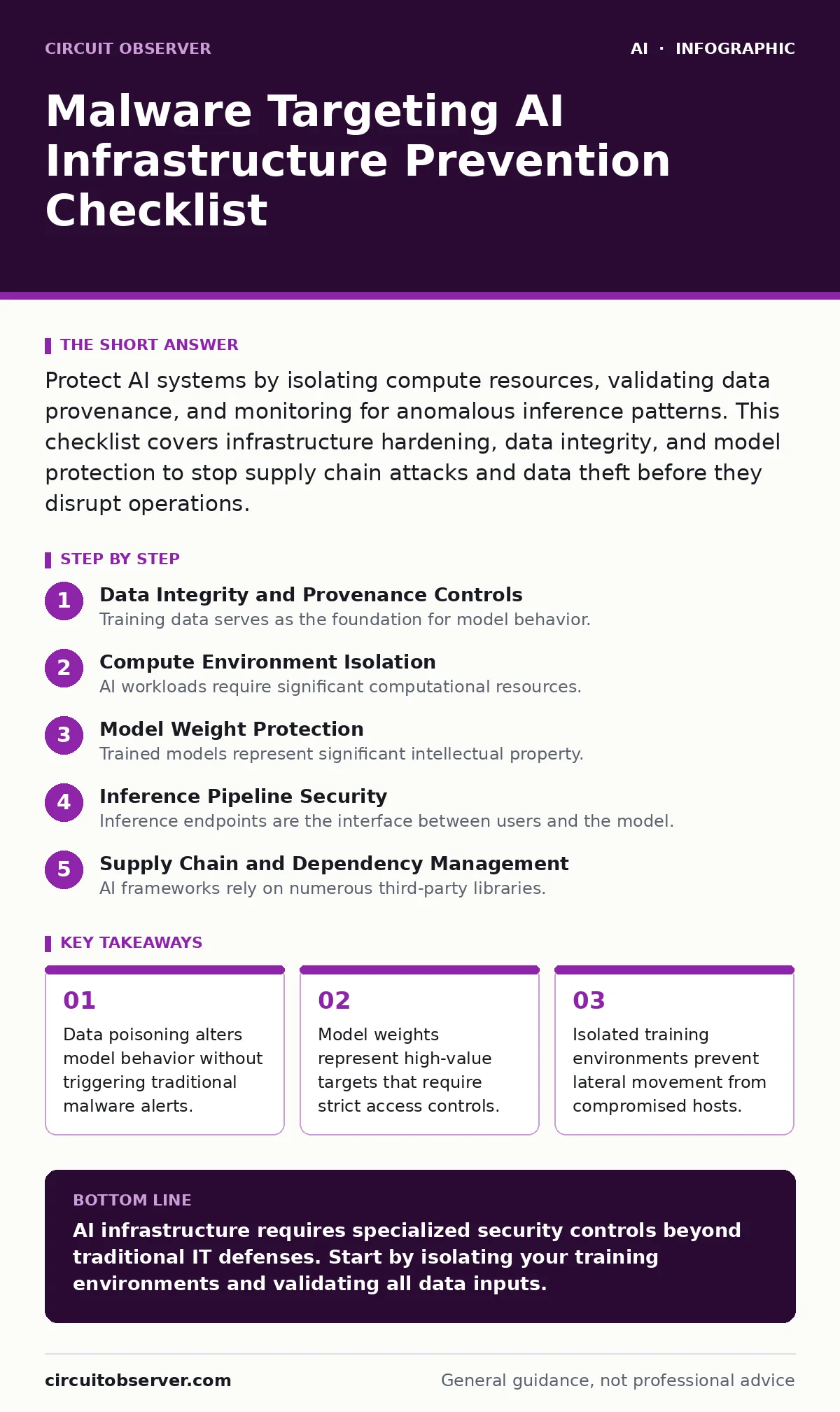
Compute Environment Isolation
AI workloads require significant computational resources. These high-value targets attract malware designed to hijack processing power or exfiltrate proprietary models. Standard virtual machine isolation is insufficient when containers share the same kernel. An attacker who escapes a container can compromise the entire host.
- Use hardware-level isolation for sensitive training jobs: prevents kernel-level exploits from affecting other workloads.
- Restrict network egress from training nodes: stops malware from communicating with command and control servers.
- Apply least-privilege permissions to service accounts: limits the impact of credential theft within the cluster.
- Monitor GPU utilization for unusual patterns: detects cryptojacking or unauthorized model training activities.
- Disable unused ports and services on AI servers: reduces the attack surface available to lateral movers.
Container escapes are a common entry point for infrastructure malware. Suppose an attacker exploits a vulnerability in a container runtime. They gain root access to the host machine. From there, they can access other containers and steal sensitive data. Hardware isolation adds a cost but provides a critical barrier. You must balance performance needs with security requirements. See our section on shadow AI to understand how untracked compute resources create hidden vulnerabilities.
Model Weight Protection
Trained models represent significant intellectual property. Adversaries target these weights to reverse-engineer proprietary algorithms or clone services. Storing models in accessible repositories without encryption invites theft. Even encrypted models are vulnerable if keys are exposed.
- Encrypt model weights at rest and in transit: prevents unauthorized reading if storage is compromised.
- Implement strict access controls for model registries: ensures only authorized personnel can retrieve or update models.
- Use ephemeral storage for inference sessions: deletes model data after use to reduce exposure time.
- Monitor for unusual download patterns of model artifacts: detects bulk exfiltration attempts by insiders or attackers.
- Separate model storage from training infrastructure: limits access to production models from development environments.
Model theft is often silent. An attacker copies the weights and leaves. You may not notice until a competitor launches a similar service. Watermarking can help identify stolen models, but it does not prevent the theft. Combine watermarking with strict access controls. Review our guide on AI watermarking for techniques to embed ownership signals in your models.
Inference Pipeline Security
Inference endpoints are the interface between users and the model. Attackers target these endpoints to extract training data or manipulate outputs. Prompt injection attacks trick the model into revealing sensitive information. Rate limiting helps but does not stop sophisticated extraction attacks.
- Sanitize all inputs before passing them to the model: blocks prompt injection and code execution attempts.
- Implement output filtering and validation: prevents the model from leaking sensitive data or generating harmful content.
- Monitor for high-frequency queries from single sources: detects model extraction attempts that reconstruct training data.
- Use separate endpoints for different model versions: isolates vulnerabilities and allows for rapid rollback.
- Log all inference requests for audit purposes: provides evidence for incident response and compliance reviews.
Model extraction attacks involve querying the model repeatedly to map its decision boundaries. This process can reconstruct the underlying training data. You must detect these patterns early. Standard web application firewalls often miss these attacks because they look like normal traffic. Specialized detection is required. Read about LLM guardrails to learn how to protect your inference endpoints effectively.
See also: Large Language Models as Optimizers: Why Your Code Changes Break · Injection attacks examples: how prompt leaks break AI systems
Supply Chain and Dependency Management
AI frameworks rely on numerous third-party libraries. A single compromised dependency can infect the entire pipeline. Adversaries often target popular packages to reach a wide audience. Verifying the integrity of every dependency is challenging but necessary.
- Pin library versions to specific hashes: prevents automatic updates from introducing malicious code.
- Scan dependencies for known vulnerabilities regularly: identifies risky packages before they are deployed.
- Verify the authenticity of package signatures: ensures libraries come from trusted sources.
- Isolate build environments from production: prevents compromised build tools from affecting live systems.
- Maintain an inventory of all software components: provides visibility into the supply chain for rapid response.
Supply chain attacks are increasingly common. Imagine a widely used AI library receives a malicious update. Organizations that automatically update their dependencies inherit the malware. Pinning versions and verifying signatures adds friction but prevents mass compromise. You must balance automation with security. Check our guide on AI governance for policies to manage third-party risks.
Key takeaways
- Data poisoning alters model behavior without triggering traditional malware alerts.
- Model weights represent high-value targets that require strict access controls.
- Isolated training environments prevent lateral movement from compromised hosts.
AI infrastructure requires specialized security controls beyond traditional IT defenses. Start by isolating your training environments and validating all data inputs.
Frequently asked questions
How do I detect data poisoning in real-time?
Monitor statistical distributions of input data for sudden shifts. Baseline normal behavior and alert on deviations.
Can traditional antivirus stop AI malware?
No. Traditional tools focus on file signatures. AI malware often uses legitimate scripts to manipulate data or steal models.
What is the biggest risk to AI models?
Data poisoning and model theft. These attacks compromise the integrity and confidentiality of your AI assets.
Should I use open-source AI frameworks?
Yes, but verify all dependencies. Open-source allows for community scrutiny but requires rigorous supply chain management.
How this guide was produced: written by the Circuit Observer editorial team with AI assistance, checked against the public references listed below, and reviewed when the facts change. See our editorial policy or report an error.