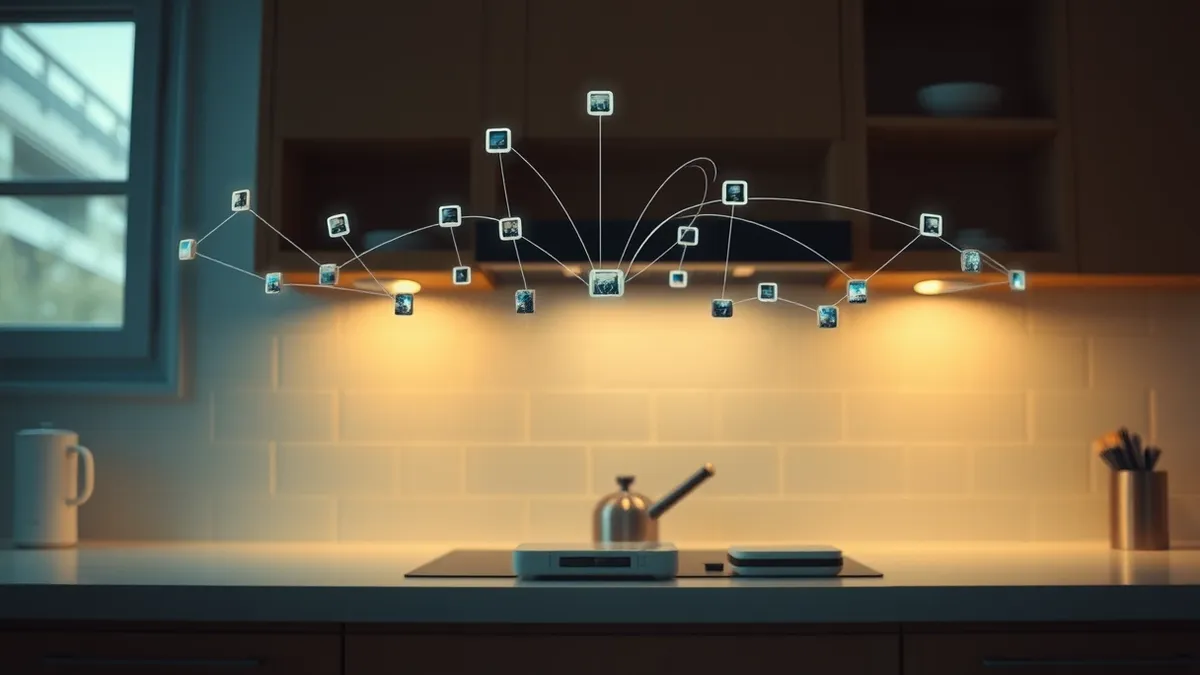
The Internet of Things is called that because everyday physical objects gain network interfaces, turning standard hardware into addressable network nodes. Instead of humans typing data into computers, physical things generate telemetry, receive commands, and interact directly with digital infrastructure without requiring direct human mediation.
Why is internet of things called that precisely
The phrase Internet of Things describes a network architecture where physical items independently transmit state changes over data links. Traditional networks connected general-purpose computers operated by people sitting at desks. This newer paradigm connects everyday machinery, sensors, and appliances directly to routing infrastructure, making physical objects first-class participants in digital communication.
Physical hardware historically remained dumb, meaning a valve turned only when a human hand twisted metal. Attaching microcontrollers and network radios to that valve transformed a mechanical assembly into a node that broadcasts pressure levels and accepts remote actuation commands. The "things" part emphasizes that the endpoints are ordinary physical articles rather than desktop workstations or servers.
Naming conventions often obscure operational realities, but this specific term highlights a profound architectural inversion. Humans no longer act as the primary generators of digital data flowing across wide-area networks. Autonomous sensors measure temperature, vibration, and flow rates continuously, flooding collection systems with automated telemetry that outpaces human typing by orders of magnitude.
The linguistic weight of connecting physical objects
Linguistic weight rests on the word things because it erases the boundary between computing hardware and mundane physical matter. A light bulb is no longer just glass and tungsten; it becomes a host running a lightweight operating system and a network stack. This semantic shift changes how administrators conceptualize asset inventories and attack surfaces.
Network visibility degrades immediately when physical things outnumber traditional servers. A database administrator knows how to audit a Linux host running file services, but struggle to maintain visibility over hundreds of smart thermostats deployed across ceiling spaces. Each physical item runs specialized firmware that rarely supports standard administrative tooling or monitoring agents.
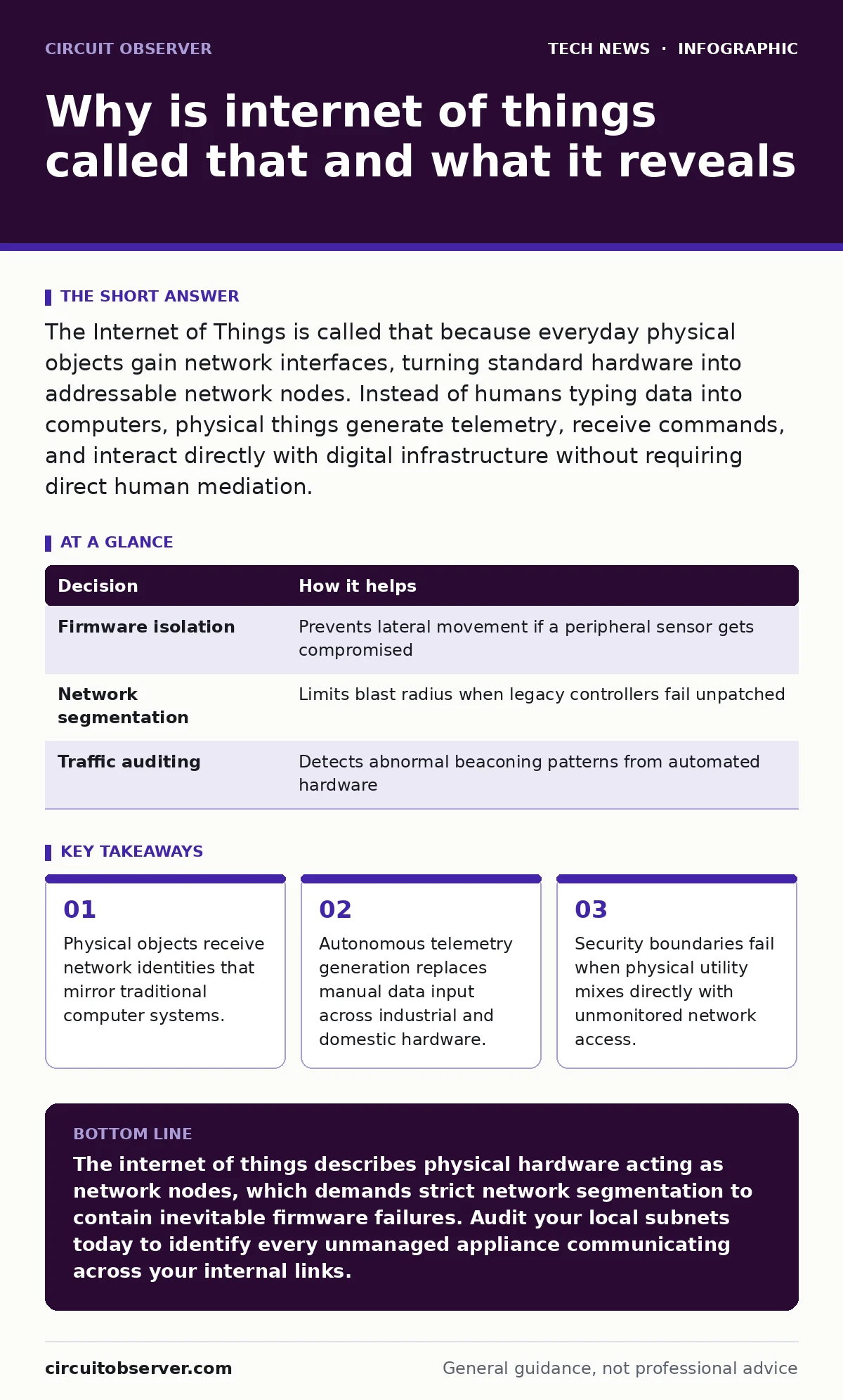
| Decision | How it helps |
|---|---|
| Firmware isolation | Prevents lateral movement if a peripheral sensor gets compromised |
| Network segmentation | Limits blast radius when legacy controllers fail unpatched |
| Traffic auditing | Detects abnormal beaconing patterns from automated hardware |
Hidden costs of autonomous physical telemetry
Autonomous telemetry introduces persistent processing overhead that drains battery reserves and overwhelms central ingestion pipelines. Physical sensors often wake up every few seconds to broadcast measurements, creating massive volumes of small, repetitive network packets. This constant chatter saturates low-throughput wireless links and forces backend database engines to handle write loads they were never designed to absorb.
Maintenance cycles change dramatically when physical things require software updates instead of mechanical lubrication. A traditional pump might run for decades with simple oil changes, but its digital counterpart demands continuous patch management to address newly discovered firmware vulnerabilities. Hardware longevity thus becomes tied to software support lifecycles managed by third-party vendors who abandon older models quickly.
Hidden failure modes in physical network integration
Network integration fails when administrators treat physical hardware with the same security assumptions applied to desktop endpoints. Smart devices often lack hardware root of trust anchors, meaning attackers can flash malicious firmware directly onto the storage chips if they gain physical access. Once compromised, these devices sit quietly inside the perimeter, trusting internal communications implicitly.
Another non-obvious consequence involves supply chain opacity, where physical assemblies contain dozens of disparate software libraries compiled by anonymous contractors. When a vulnerability emerges in an embedded networking stack, tracing which physical models contain that specific library proves nearly impossible. Administrators cannot patch what they cannot inventory accurately.
How to manage unmanaged physical hardware inventories
Managing physical hardware inventories requires automated discovery protocols that probe local subnets for unconventional device fingerprints. Because smart appliances rarely run standard management agents, network administrators must rely on passive traffic analysis to identify what is talking to local gateways. Inspecting DHCP lease requests and DNS query patterns reveals unauthorized peripherals plugged into sensitive network segments.
Enforcing strict boundary controls prevents physical things from phoning home to arbitrary cloud endpoints without authorization. Administrators should route all outbound telemetry through local proxies that strip identifying metadata and inspect payloads for command-and-control signatures. Integrating mobile device security principles helps extend strict provisioning policies to non-traditional hardware endpoints.
See also: List of Ports and Protocols: How to Map and Secure Your Network · OSI Model Acronym: What Each Layer Does for Your Network Security
What to do with your network topology knowledge
Network topology knowledge must translate into aggressive micro-segmentation strategies that isolate physical sensors from core business infrastructure. Place every smart appliance onto a dedicated, air-gapped VLAN with no routing path back to financial databases or human-operated workstations. This containment strategy ensures that a compromised temperature sensor cannot pivot toward sensitive file storage.
Establish rigorous hardware decommissioning procedures that permanently wipe non-volatile memory before physical items leave the facility for recycling. Smart devices retain Wi-Fi credentials, API keys, and internal state history inside flash memory chips that standard disposal processes miss entirely. Treat every discarded sensor as a potential data leak waiting to be exploited.
Key takeaways
- Physical objects receive network identities that mirror traditional computer systems.
- Autonomous telemetry generation replaces manual data input across industrial and domestic hardware.
- Security boundaries fail when physical utility mixes directly with unmonitored network access.
The internet of things describes physical hardware acting as network nodes, which demands strict network segmentation to contain inevitable firmware failures. Audit your local subnets today to identify every unmanaged appliance communicating across your internal links.
Frequently asked questions
Why did physical objects need network interfaces in the first place?
Industrial operators sought real-time telemetry to reduce manual inspection costs and automate maintenance triggers before physical components failed catastrophically.
What differentiates an embedded system from a traditional computer workstation?
Embedded systems lack general-purpose input peripherals like keyboards and screens, running dedicated firmware built for a single physical task.
How do smart appliances communicate without human intervention?
Background daemons running on local microcontrollers package sensor readings into structured packets and transmit them automatically over wireless or wired links.
Why are firmware updates difficult to apply to physical devices?
Many physical items lack automatic update mechanisms, requiring physical access or risky manual flashing procedures that can brick the hardware if interrupted.
How this guide was produced: written by the Circuit Observer editorial team with AI assistance, checked against the public references listed below, and reviewed when the facts change. See our editorial policy or report an error.