
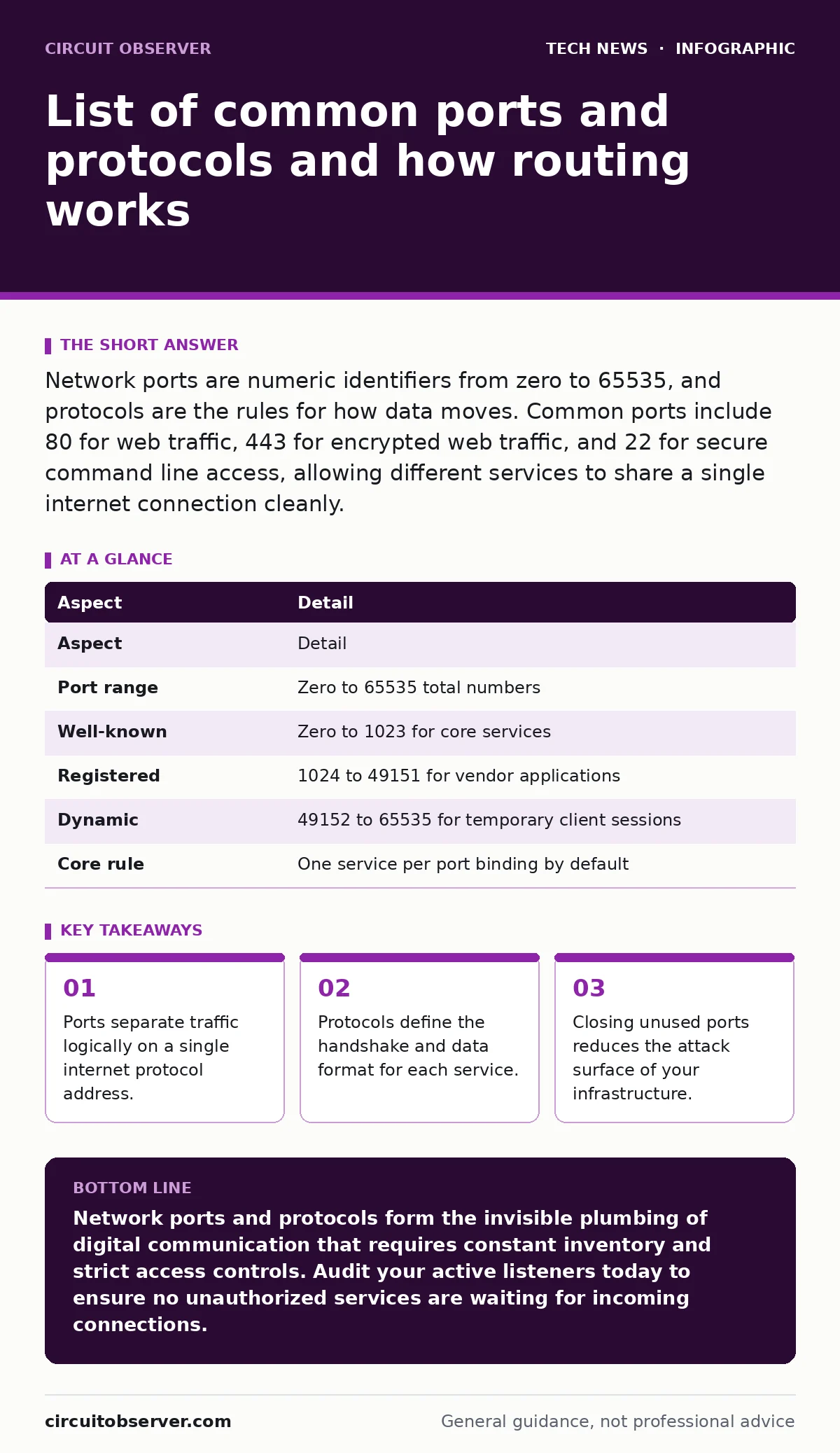
Network ports are numeric identifiers from zero to 65535, and protocols are the rules for how data moves. Common ports include 80 for web traffic, 443 for encrypted web traffic, and 22 for secure command line access, allowing different services to share a single internet connection cleanly.
How Network Ports and Protocols Direct Traffic
Imagine an apartment building where every tenant shares a single street address, but mail delivery requires a specific apartment number to reach the right person. Network ports serve as those numeric apartment numbers, while protocols provide the shared language for the conversation once the door opens. Without these routing markers, a server receiving data from the outside world would have no way to know whether incoming packets belong to a web browser, a mail server, or a remote management session.
| Aspect | Detail |
|---|---|
| Aspect | Detail |
| Port range | Zero to 65535 total numbers |
| Well-known | Zero to 1023 for core services |
| Registered | 1024 to 49151 for vendor applications |
| Dynamic | 49152 to 65535 for temporary client sessions |
| Core rule | One service per port binding by default |
Mechanics of Ports and Protocols
Operating systems manage network traffic through software bindings where a specific daemon listens on a designated numeric identifier. When an external packet arrives, the networking stack inspects the destination number and hands the payload to the matching application process.
Transport layer protocols govern how reliable this delivery must be. Transmission Control Protocol guarantees packet delivery through acknowledgments and retransmissions, creating a synchronized session. User Datagram Protocol abandons these checks for raw speed, sending packets outward without confirming receipt.
A List of Common Ports and Protocols
Standardized assignments prevent applications from colliding over the same digital real estate on a crowded server. Core infrastructure relies heavily on these predictable endpoints to function smoothly across diverse hardware.
- Port 80 handles unencrypted hypertext transfer protocol traffic for basic web browsing.
- Port 443 secures web traffic using transport layer security for encrypted sessions.
- Port 22 runs secure shell connections for encrypted remote administration.
- Port 53 resolves domain name system queries translating hostnames to addresses.
- Port 21 manages file transfer protocol sessions for moving documents.
Who Is Affected by Open Ports
System administrators, network engineers, and security analysts manage the exposure of these numeric pathways daily. Every active listener represents a potential entry point for unauthorized actors scanning the perimeter for vulnerable software.
Developers writing network-facing applications must also understand these bindings to avoid hardcoding assumptions that break in locked-down environments. End users rarely interact with these numbers directly, yet their daily tools depend entirely on correct routing behind the scenes.
What to Do About Port Exposure
Auditing your network perimeter requires looking inward at what local services are currently accepting connections from external interfaces. You should configure host-based firewalls to drop traffic destined for unneeded listeners rather than relying solely on network edge devices.
Restrict administrative ports like secure shell to internal management networks or secure VPN tunnels rather than exposing them directly to the public internet. Regular vulnerability scans help surface accidental service bindings before automated scanners find them.
See also: Why is internet of things called that and what it reveals
What People Usually Get Wrong
A common misconception treats port numbers as security boundaries, assuming that changing a service from its default number to a random one provides real defense. Security through obscurity fails because automated scanning tools quickly map all active listeners regardless of their assigned numbers.
Another frequent error involves assuming that closing a port stops all risk, while ignoring the underlying protocol vulnerabilities that might be exploited even on authorized ports. Proper protection requires examining both the endpoint number and the application logic processing the incoming data.
Key takeaways
- Ports separate traffic logically on a single internet protocol address.
- Protocols define the handshake and data format for each service.
- Closing unused ports reduces the attack surface of your infrastructure.
Network ports and protocols form the invisible plumbing of digital communication that requires constant inventory and strict access controls. Audit your active listeners today to ensure no unauthorized services are waiting for incoming connections.
Frequently asked questions
Can two different applications use the same port on the same machine?
Operating systems generally prevent two programs from binding to the exact same port and protocol combination simultaneously.
What is the difference between TCP and UDP ports?
Ports themselves are just numbers, but the transport protocol determines whether the connection is connection-oriented with error checking or connectionless without guarantees.
Why do attackers scan port ranges?
Scanning reveals which applications are running on a machine, pointing potential intruders toward outdated software versions with known vulnerabilities.
How do firewalls interact with ports?
Firewalls inspect incoming and outgoing packets, blocking or permitting traffic based on rules tied to source and destination port numbers.
How this guide was produced: written by the Circuit Observer editorial team with AI assistance, checked against the public references listed below, and reviewed when the facts change. See our editorial policy or report an error.