
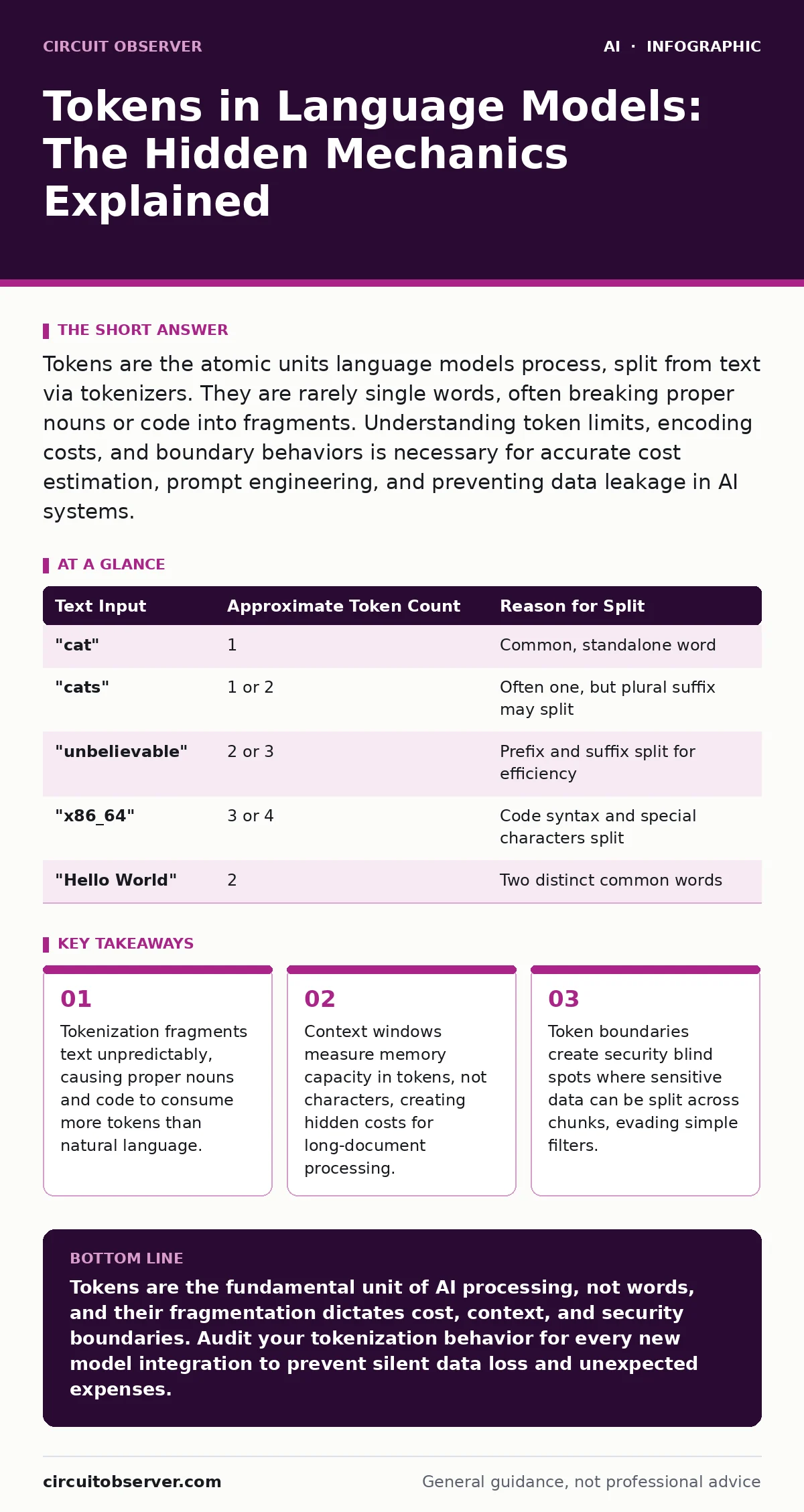
Tokens are the atomic units language models process, split from text via tokenizers. They are rarely single words, often breaking proper nouns or code into fragments. Understanding token limits, encoding costs, and boundary behaviors is necessary for accurate cost estimation, prompt engineering, and preventing data leakage in AI systems.
What exactly is a token in a language model?
A token is a numerical representation of a text fragment that the model processes, rather than a whole word. Think of it as the model's vocabulary unit, which can be a full word, a part of a word, or even a single character. When you type a sentence, a tokenizer breaks it into these pieces before the AI ever "reads" them. This fragmentation means the model understands structure, not meaning, at the input stage.
Why does one word sometimes equal multiple tokens?
Tokenizers use statistical analysis to split text into the most efficient chunks for prediction. Common words like "the" are usually one token, but rare words or complex terms often break into several pieces. For example, a proper noun like "Microsoft" might split into "Micro" and "soft" because the model has seen those sub-parts more often than the whole brand name. This fragmentation allows the model to handle unknown words by combining known parts, but it increases the token count for specialized terminology.
| Text Input | Approximate Token Count | Reason for Split |
|---|---|---|
| "cat" | 1 | Common, standalone word |
| "cats" | 1 or 2 | Often one, but plural suffix may split |
| "unbelievable" | 2 or 3 | Prefix and suffix split for efficiency |
| "x86_64" | 3 or 4 | Code syntax and special characters split |
| "Hello World" | 2 | Two distinct common words |
How do token limits affect my application?
Token limits define the maximum context window, which is the total amount of text the model can consider at one time. This includes both your input prompt and the model's output generation. If you exceed this limit, the oldest text is usually dropped, causing the model to lose earlier instructions or data. You must track the token count of your entire conversation history, not just the current message, to avoid silent data loss.
Does tokenization change the meaning of my data?
Yes, because tokenization is a lossy compression method that strips away whitespace and punctuation structure. The model sees a sequence of IDs, not the original formatting. This can lead to subtle shifts in intent, especially when handling code or structured data like JSON. If a tokenizer splits a variable name incorrectly, the model may fail to recognize it as a single entity. This is why prompt engineering often requires explicit formatting cues to maintain structural integrity.
How do I calculate the cost of API usage?
Most AI providers charge per token, with different rates for input and output. Input tokens are generally cheaper because the model only reads them, while output tokens are more expensive because the model generates them computationally. You must count both the system prompt, user messages, and the expected response length. Ignoring the system prompt's token cost leads to budget overruns, as these instructions persist in every request.
See also: How Tokenization Works: Mapping Data to Unbreakable Tokens
Can tokenization hide sensitive data from filters?
Token boundaries can fragment sensitive information in ways that evade simple keyword filters. If a credit card number is split across three tokens, a filter looking for the full string may miss it. This is a significant risk in sensitive data leaks through AI chatbots, where compliance tools scan for whole patterns. You must implement semantic detection that understands context, not just regex matching on raw text, to catch fragmented leaks.
Why does code consume more tokens than prose?
Code contains many unique symbols, variable names, and syntax structures that tokenizers treat as rare or unknown. A single line of Python might generate more tokens than a paragraph of English because each function call and bracket is a distinct unit. This inefficiency makes code generation and analysis significantly more expensive per line of logic. Optimizing code for token efficiency often conflicts with human readability, creating a trade-off you must manage.
How do different models handle tokens differently?
Each model uses its own tokenizer, trained on specific data sets and vocabulary sizes. A text that is ten tokens in one model might be twelve in another. This inconsistency means you cannot assume portability of token counts across different AI providers. When migrating systems, you must re-evaluate your context window usage and cost projections for the new tokenizer. This variability is a key consideration in AI governance, ensuring consistent behavior across diverse toolchains.
What is the impact of tokenization on latency?
Latency increases with the number of tokens, as the model must process each unit sequentially. Larger context windows mean more computation per request, slowing down response times. Additionally, the tokenizer itself adds overhead, as it must parse and encode the input text before the model begins inference. For real-time applications, minimizing token count is as important as minimizing code complexity. This performance characteristic is critical when integrating AI into AI in security operations, where speed determines threat response capability.
How can I debug token-related errors?
Use the provider's native counting tools to visualize how your input splits into tokens. Most APIs return the token count in the response header, allowing you to audit your usage. If the model behaves unexpectedly, inspect the tokenized output to see if key terms were fragmented. This debugging step is often overlooked, leading administrators to blame the model's intelligence rather than the input encoding. Proper monitoring aligns with best practices in AI model monitoring, ensuring data integrity throughout the pipeline.
Key takeaways
- Tokenization fragments text unpredictably, causing proper nouns and code to consume more tokens than natural language.
- Context windows measure memory capacity in tokens, not characters, creating hidden costs for long-document processing.
- Token boundaries create security blind spots where sensitive data can be split across chunks, evading simple filters.
Tokens are the fundamental unit of AI processing, not words, and their fragmentation dictates cost, context, and security boundaries. Audit your tokenization behavior for every new model integration to prevent silent data loss and unexpected expenses.
Frequently asked questions
Can I convert characters directly to tokens?
No, there is no fixed ratio. Token count depends on the specific tokenizer and the text's complexity, varying widely between languages and domains.
Does punctuation count as a token?
Yes, punctuation marks are often separate tokens, especially when attached to words. This increases the total count beyond just the alphabetic characters.
How do I prevent token limit errors?
Implement dynamic truncation strategies that prioritize recent context over older history, and monitor token counts in real-time before sending requests.
Are all tokenizers the same?
No, each model provider uses a unique tokenizer with different vocabulary sizes and splitting rules, affecting how text is encoded and processed.
How this guide was produced: written by the Circuit Observer editorial team with AI assistance, checked against the public references listed below, and reviewed when the facts change. See our editorial policy or report an error.