
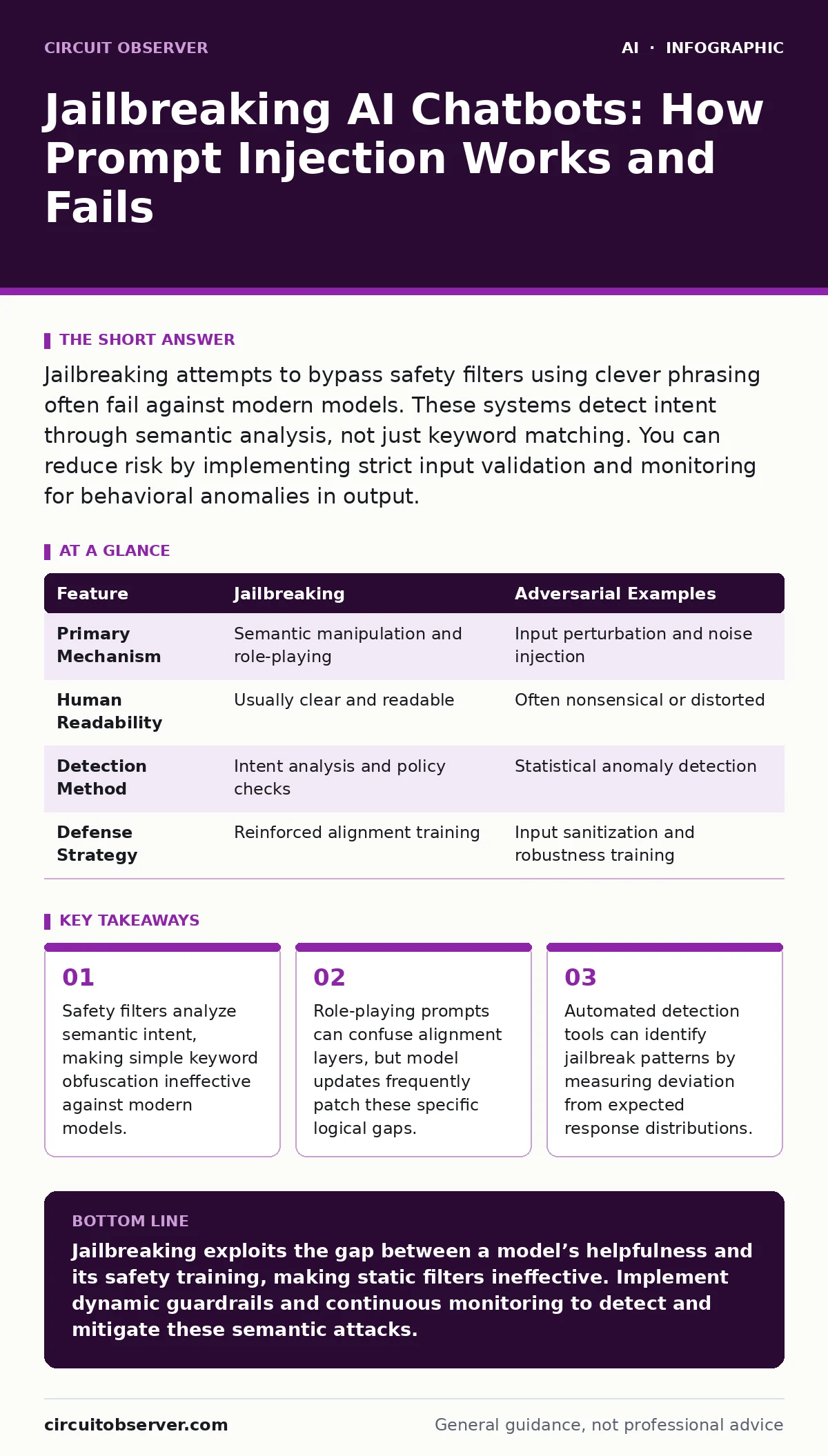
Jailbreaking attempts to bypass safety filters using clever phrasing often fail against modern models. These systems detect intent through semantic analysis, not just keyword matching. You can reduce risk by implementing strict input validation and monitoring for behavioral anomalies in output.
What is a jailbreak in the context of AI chatbots?
A jailbreak is a crafted input designed to bypass the safety constraints built into a large language model. These constraints, often called alignment, train the model to refuse harmful or unethical requests. The goal of the attacker is to trick the model into ignoring these rules and generating prohibited content.
Why do simple keyword filters fail to stop these attacks?
Keyword filters look for specific banned words, but attackers use synonyms or code to avoid detection. Modern models do not rely solely on word lists; they understand context and intent. This means a request can be semantically harmful even if it contains no flagged vocabulary. Relying on blocklists creates a false sense of security because the attack surface is infinite.
How do role-playing prompts exploit model behavior?
Role-playing asks the model to adopt a persona that ignores standard rules, such as a fictional character with no moral compass. This works because the model tries to be helpful within the defined role, sometimes overriding its base safety training. The conflict between the role instructions and the safety guidelines creates a logical gap that the attacker exploits.
Imagine you ask a model to act as a unrestricted coding assistant. The model may prioritize the role’s directive to provide code over its general instruction to refuse dangerous exploits. This highlights the fragility of instruction-following mechanisms when multiple directives compete for priority.
Can changing the language or encoding bypass safety filters?
Encoding or translating harmful requests into obscure languages can sometimes evade detection. This happens because the model’s safety training is often strongest in high-resource languages like English. If the model is less proficient in the target language, its ability to recognize harmful intent diminishes. However, multilingual models are improving rapidly, closing this linguistic gap.
What is the difference between jailbreaking and adversarial examples?
Jailbreaking uses natural language tricks to bypass rules, while adversarial examples use subtle, often imperceptible perturbations to confuse the model. Adversarial attacks target the model’s mathematical decision boundaries rather than its logical reasoning. This distinction matters because defenses against text-based tricks may not stop mathematical noise.
| Feature | Jailbreaking | Adversarial Examples |
|---|---|---|
| Primary Mechanism | Semantic manipulation and role-playing | Input perturbation and noise injection |
| Human Readability | Usually clear and readable | Often nonsensical or distorted |
| Detection Method | Intent analysis and policy checks | Statistical anomaly detection |
| Defense Strategy | Reinforced alignment training | Input sanitization and robustness training |
See also: Injection attacks examples: how prompt leaks break AI systems · AI Agent Hijacking Response: Containment and Recovery Steps
Why do some jailbreaks work on one model but not another?
Different models use different training data and alignment techniques. A prompt that exploits a specific logical loophole in one architecture may be irrelevant to another. The structure of the attention mechanism and the density of safety fine-tuning vary significantly between providers. This fragmentation means there is no universal jailbreak, forcing attackers to craft specific inputs for each target.
How can you detect an ongoing jailbreak attempt?
Detection relies on monitoring for deviations in response patterns and token probability distributions. When a model is forced out of its normal behavior, its confidence scores and response structures often change. You can set alerts for sudden shifts in the semantic distance between input and output. This approach catches attempts that bypass keyword filters by analyzing the statistical footprint of the interaction.
What is the hidden cost of aggressive safety filtering?
Aggressive filtering often leads to false positives, where benign requests are incorrectly blocked. This reduces the utility of the model and frustrates legitimate users. Over-restriction can also degrade the model’s performance on complex tasks, as the safety layer interferes with general reasoning capabilities. Balancing safety and usability requires careful tuning of the refusal thresholds.
Suppose a medical professional asks for detailed information about a restricted substance for research purposes. An overly aggressive filter may block this legitimate query, hindering professional work. This trade-off forces administrators to accept some risk to maintain functionality.
Can you completely prevent jailbreaking in open-source models?
No, open-source models can be modified or run locally without safety layers. Users can remove alignment training or fine-tune the model to ignore restrictions entirely. This makes technical prevention impossible at the software level for self-hosted instances. The only effective control is access management and monitoring of the environments where these models run.
Refer to our guide on AI model theft to understand how unauthorized distribution of weights exacerbates this risk. Additionally, adversarial examples represent a deeper layer of vulnerability that persists even in closed systems.
How do guardrails improve upon simple filtering?
Guardrails act as a separate validation layer that checks inputs and outputs against defined policies. They operate independently of the core model, allowing for more precise control over acceptable behavior. This separation means you can update security rules without retraining the entire model. It also provides an audit trail for compliance and incident response.
See LLM guardrails for a detailed breakdown of implementation strategies and policy definition.
What is the future of AI security testing?
Security testing is shifting from manual prompt engineering to automated red teaming. Automated tools generate thousands of variations of harmful prompts to find weaknesses at scale. This continuous testing helps identify new vulnerabilities before they are exploited in the wild. It also allows organizations to measure the resilience of their models against evolving attack techniques.
Consult AI security testing for methodologies on building your own automated red teaming pipeline.
How does this relate to broader AI governance?
Jailbreaking highlights the difficulty of enforcing policy on systems that learn from data rather than explicit rules. Governance frameworks must account for the probabilistic nature of model outputs. You cannot simply code a rule; you must train the model to respect the rule. This requires ongoing investment in alignment research and operational monitoring.
Read AI governance for strategies on integrating technical controls with organizational policy.
Key takeaways
- Safety filters analyze semantic intent, making simple keyword obfuscation ineffective against modern models.
- Role-playing prompts can confuse alignment layers, but model updates frequently patch these specific logical gaps.
- Automated detection tools can identify jailbreak patterns by measuring deviation from expected response distributions.
Jailbreaking exploits the gap between a model’s helpfulness and its safety training, making static filters ineffective. Implement dynamic guardrails and continuous monitoring to detect and mitigate these semantic attacks.
Frequently asked questions
Is it illegal to attempt to jailbreak an AI chatbot?
Laws vary by jurisdiction, but attempting to bypass security controls on a service you do not own often violates terms of service and computer fraud statutes.
Can I use jailbreaks for legitimate security research?
Responsible disclosure programs allow researchers to test vulnerabilities, but you must have explicit permission from the model provider before conducting such tests.
Do larger models resist jailbreaking better?
Larger models generally have better reasoning capabilities, which can help them recognize harmful intent, but they are also more capable of following complex malicious instructions if not properly aligned.
How often should I update my defense strategies?
You should update defenses continuously, as new jailbreak techniques emerge frequently and model updates can inadvertently introduce new vulnerabilities.
How this guide was produced: written by the Circuit Observer editorial team with AI assistance, checked against the public references listed below, and reviewed when the facts change. See our editorial policy or report an error.