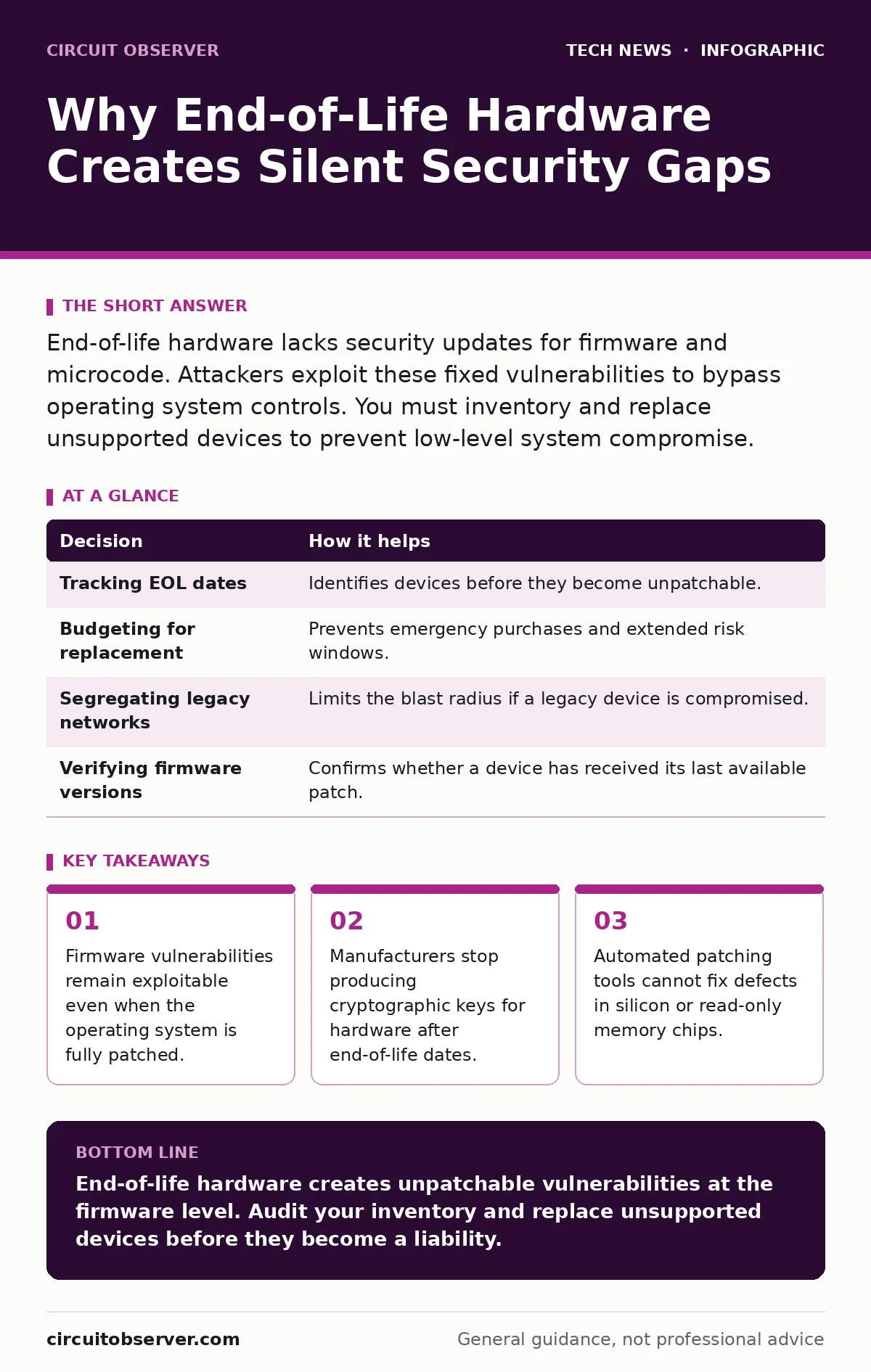
End-of-life hardware lacks security updates for firmware and microcode. Attackers exploit these fixed vulnerabilities to bypass operating system controls. You must inventory and replace unsupported devices to prevent low-level system compromise.
The Hidden Layer of Risk
Most security teams focus on operating systems and applications. This focus misses the hardware foundation beneath them. When a manufacturer declares hardware end-of-life, they stop providing updates for firmware. Firmware is the low-level software embedded in chips that controls basic functions. Unlike operating systems, you cannot easily reinstall or patch firmware on old devices. The code remains static, preserving any known defects forever. Attackers scan for these static targets because they know the vendors will never fix them. This creates a permanent gap in your defense strategy.
Firmware vs Software Updates
Software updates fix bugs in the code you can change. Firmware updates fix bugs in the code that runs before the operating system loads. If a vulnerability exists in the Basic Input Output System or Unified Extensible Firmware Interface, it loads before your security software starts. This means your endpoint detection tools are blind to the initial compromise. The attacker has control of the hardware instruction set before your defenses activate. You cannot patch this with a standard software update. The hardware itself becomes the vector for entry.
The Cryptographic Decay Problem
Hardware security relies on cryptographic keys stored in secure elements. Manufacturers generate these keys when the device is built. When hardware reaches end-of-life, the manufacturer may revoke the root certificates used to sign firmware updates. This prevents you from verifying the authenticity of new code. Even if a patch existed, you could not safely install it. The hardware loses its ability to prove its own integrity. This breaks the chain of trust that modern security architectures require. Your device can no longer securely communicate with your management infrastructure.
Supply Chain and Replacement Parts
Finding replacement parts for end-of-life hardware is difficult. You often rely on third-party resellers who may not verify the component history. A replaced hard drive or memory module could contain pre-installed malware. This is known as a supply chain attack. You cannot trust the physical integrity of components from unknown sources. The risk extends beyond software to the physical silicon itself. Tampered chips can alter data at the hardware level, leaving no trace in software logs. This makes forensic analysis nearly impossible.
Inventory and Lifecycle Management
You need a precise inventory of every hardware asset. This includes servers, network switches, and storage arrays. Each item has a specific end-of-life date set by the manufacturer. Tracking these dates requires a dedicated asset management system. You must map each device to its support status. This mapping informs your replacement budget and timeline. Without this data, you are guessing which devices are vulnerable. Guessing leaves critical infrastructure exposed to known exploits. Proactive replacement prevents these issues before they occur.
| Decision | How it helps |
|---|---|
| Tracking EOL dates | Identifies devices before they become unpatchable. |
| Budgeting for replacement | Prevents emergency purchases and extended risk windows. |
| Segregating legacy networks | Limits the blast radius if a legacy device is compromised. |
| Verifying firmware versions | Confirms whether a device has received its last available patch. |
See also: USB Security Mistakes: 7 Hidden Risks and How to Fix Them
Mitigation Without Replacement
Sometimes you cannot replace hardware immediately due to budget or compatibility. In these cases, you must isolate the device. Network segmentation restricts what the device can communicate with. You should disable unnecessary services and ports. This reduces the attack surface available to potential adversaries. You must also monitor traffic to and from the device closely. Look for unusual data flows or commands. While this does not fix the underlying vulnerability, it limits the damage. It buys you time until replacement is possible.
Integration with Broader Security
Hardware security does not exist in isolation. It interacts with other security layers. For instance, if your hardware cannot support modern encryption standards, your data at rest remains vulnerable. This relates directly to data center security practices. You must ensure that storage devices support current encryption protocols. Similarly, mobile device security depends on the integrity of the device's secure enclave. If the hardware is outdated, the secure enclave may be compromised. This undermines the entire security model for remote users.
The Cost of Inaction
Keeping end-of-life hardware is cheaper in the short term. You avoid the cost of new purchases. However, the cost of a breach is far higher. Remediation involves forensic analysis, system rebuilding, and regulatory compliance. These costs dwarf the price of new hardware. Additionally, unsupported hardware lacks compatibility with modern security tools. You cannot effectively monitor or protect devices that do not speak the current language. This creates blind spots in your security posture. The savings from delaying replacement are illusory.
Planning the Transition
Transitioning away from end-of-life hardware requires careful planning. You must test new hardware for compatibility with your existing software. This ensures that replacement does not break critical workflows. You should also plan for data migration. Moving data from old to new storage requires secure transfer methods. This process must maintain data integrity and confidentiality. Failure to plan leads to operational downtime. Downtime exposes your organization to further risk. A structured approach minimizes disruption.
Key takeaways
- Firmware vulnerabilities remain exploitable even when the operating system is fully patched.
- Manufacturers stop producing cryptographic keys for hardware after end-of-life dates.
- Automated patching tools cannot fix defects in silicon or read-only memory chips.
End-of-life hardware creates unpatchable vulnerabilities at the firmware level. Audit your inventory and replace unsupported devices before they become a liability.
Frequently asked questions
Can I patch end-of-life hardware with third-party tools?
No. Third-party tools cannot fix defects in the silicon or read-only firmware. The vulnerability remains in the hardware itself.
How do I find the end-of-life date for my devices?
Check the manufacturer’s support page for each model. They publish support timelines and end-of-life notices for all products.
Is network segmentation enough to protect old hardware?
Segmentation limits exposure but does not remove the vulnerability. If an attacker gains access to the segmented network, the hardware is still exploitable.
What happens if I lose the vendor’s support contract?
You lose access to security patches and firmware updates. Your device becomes a static target with known, unfixable flaws.
How this guide was produced: written by the Circuit Observer editorial team with AI assistance, checked against the public references listed below, and reviewed when the facts change. See our editorial policy or report an error.