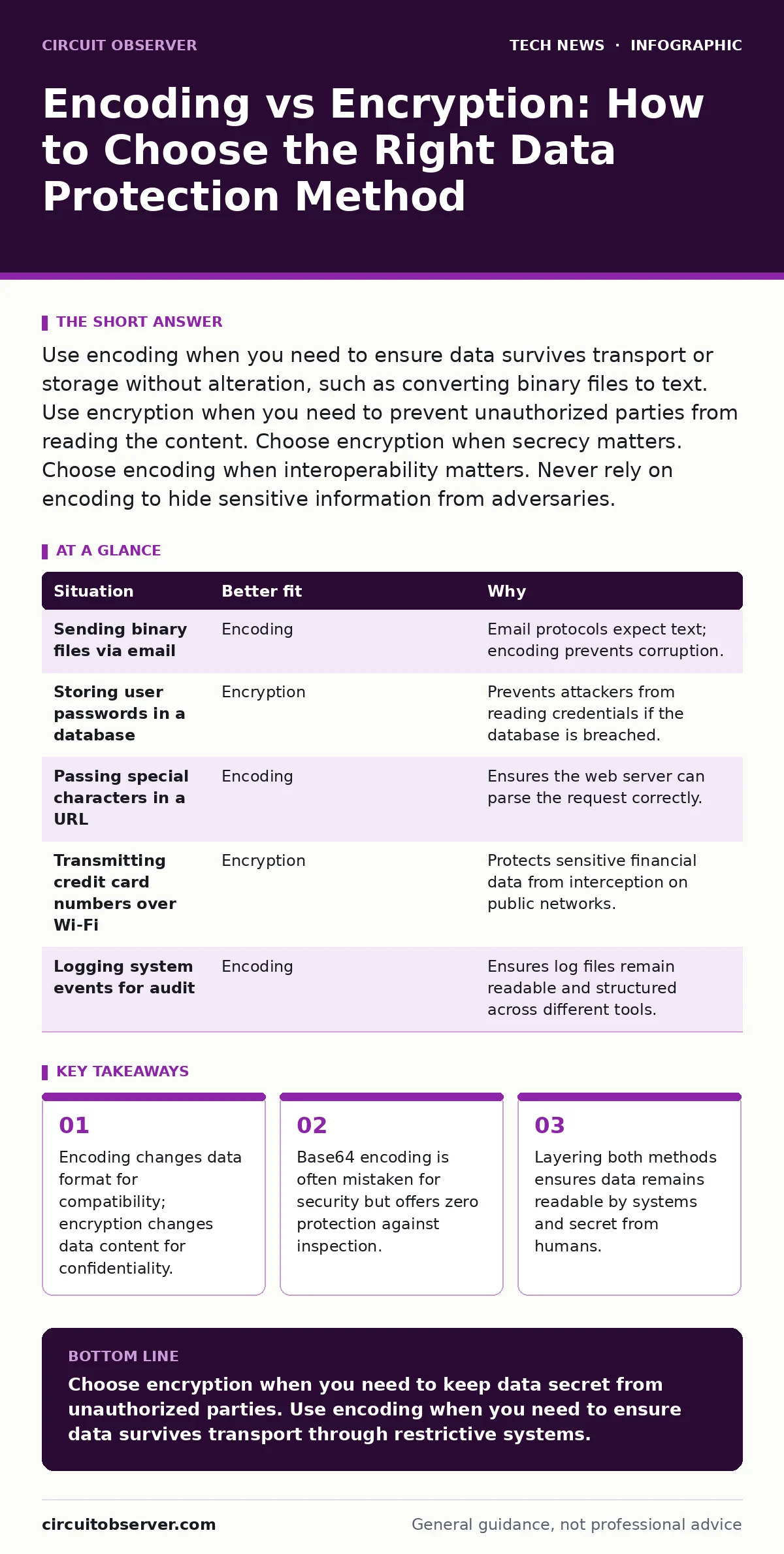
Use encoding when you need to ensure data survives transport or storage without alteration, such as converting binary files to text. Use encryption when you need to prevent unauthorized parties from reading the content. Choose encryption when secrecy matters. Choose encoding when interoperability matters. Never rely on encoding to hide sensitive information from adversaries.
Does the data need to remain secret from unauthorized readers?
Encryption is the only mechanism that prevents unauthorized access to content. It scrambles data using a mathematical algorithm and a key. Without the correct key, the data remains unreadable gibberish. If an adversary intercepts the transmission or steals the storage medium, they cannot recover the original information. This protects privacy and intellectual property. If your goal is confidentiality, you must use encryption. Encoding does not hide data. It merely changes the representation. Anyone with the encoding scheme can reverse the process instantly.
Imagine a financial transaction traveling across a public network. If you only encode it, any observer can decode the amount and recipient details. If you encrypt it, the observer sees only random noise. The difference is the presence of a secret key. Encryption adds a barrier that requires specific credentials to bypass. This barrier stops casual snooping and determined attacks alike. You must treat encryption keys with the same care as the data they protect. Losing the key means losing the data forever.
Does the system require specific character sets or formats?
Encoding ensures data survives transport through systems that expect specific formats. Many legacy protocols only accept ASCII characters. Binary data, such as images or executables, contains bytes that break these protocols. Encoding converts binary data into a safe text representation. This prevents corruption during transmission or storage. Base64 is a common standard for this task. It maps every 3 bytes of input to 4 printable characters. This allows email systems and web forms to handle attachments reliably.
Suppose you are sending a certificate file through a system that strips non-text characters. Without encoding, the file becomes corrupted and unreadable. With encoding, the file arrives intact. The receiving system decodes it back to its original binary form. This process adds no security. It only ensures fidelity. You use encoding when the destination system cannot handle raw binary data. You do not use it to hide the content. The trade-off is increased data size.
Is the data being stored in a legacy or restricted environment?
Some storage systems have strict limitations on allowed characters. Databases might reject symbols that have special meaning in query languages. Filenames might be blocked if they contain slashes or colons. Encoding resolves these conflicts by replacing problematic characters with safe alternatives. This allows web servers to route requests correctly. It ensures the data structure remains valid within the constraints of the environment.
This situation favors encoding over encryption because the goal is compatibility, not secrecy. Encrypting data for storage is also common, but it serves a different purpose. If you encrypt data before storing it in a database, you protect it from database administrators. If you encode it, you only ensure it fits the column type. You must decide if the storage medium is trusted. If the storage is untrusted, encryption is necessary. If the storage is trusted but format-restricted, encoding suffices.
Can you handle the performance overhead of cryptographic operations?
Encryption consumes computational resources. The CPU must perform complex mathematical operations to scramble and unscramble data. This adds latency to read and write operations. Encoding is computationally cheap. It involves simple lookups and substitutions. In high-throughput systems, encoding might be preferable if security is not the primary concern. However, most modern hardware includes instructions that accelerate encryption. The performance gap has narrowed significantly.
You must weigh the cost of processing against the risk of exposure. If you are transmitting massive logs, encryption might slow down the pipeline. If those logs contain passwords, encryption is mandatory despite the cost. Encoding offers no security benefit, so it is irrelevant to the risk calculation. The decision rests on whether the data has value to an attacker. If it does, the performance cost is justified. If it does not, encoding may be sufficient for integrity.
| Situation | Better fit | Why |
|---|---|---|
| Sending binary files via email | Encoding | Email protocols expect text; encoding prevents corruption. |
| Storing user passwords in a database | Encryption | Prevents attackers from reading credentials if the database is breached. |
| Passing special characters in a URL | Encoding | Ensures the web server can parse the request correctly. |
| Transmitting credit card numbers over Wi-Fi | Encryption | Protects sensitive financial data from interception on public networks. |
| Logging system events for audit | Encoding | Ensures log files remain readable and structured across different tools. |
See also: BitLocker Encryption: Real Benefits and Hidden Limitations · How FileVault Encrypts Your Mac Drive Without Slowing You Down
When should you layer both methods together?
Using both encoding and encryption provides defense in depth. You encrypt the data first to ensure secrecy. Then you encode the encrypted output to ensure it survives transport. This combination addresses both confidentiality and compatibility. The encryption layer hides the content. The encoding layer ensures the ciphertext does not break the transmission protocol. This is standard practice in many secure communication frameworks.
For example, TLS connections often encode encrypted payloads to ensure they traverse proxies correctly. The encoding adds no security, but it ensures the encrypted data arrives intact. If you skip encoding, the encrypted bytes might be misinterpreted as control characters. This causes transmission errors. By layering them, you get the benefits of both. You must remember to reverse the order on the receiving end. Decode first, then decrypt.
Related considerations include how you manage keys for API security and how you protect data at rest with FileVault. Understanding these layers helps you build a cohesive security strategy. You should also review VLANs to segment traffic that carries encoded or encrypted data. Proper segmentation reduces the blast radius if one layer fails.
Key takeaways
- Encoding changes data format for compatibility; encryption changes data content for confidentiality.
- Base64 encoding is often mistaken for security but offers zero protection against inspection.
- Layering both methods ensures data remains readable by systems and secret from humans.
Choose encryption when you need to keep data secret from unauthorized parties. Use encoding when you need to ensure data survives transport through restrictive systems.
Frequently asked questions
Can I use encoding to hide sensitive data from users?
No, encoding is reversible by anyone who knows the scheme. It provides no secrecy or protection against inspection.
Does base64 encryption protect my data?
Base64 is encoding, not encryption. It changes the format of the data but does not scramble it. It offers zero security.
When should I use both encoding and encryption?
Use both when you need to send encrypted data through a system that only accepts specific text characters, such as email or URLs.
Is encoding faster than encryption?
Yes, encoding is computationally cheaper because it uses simple substitutions. Encryption requires complex mathematical operations.
How this guide was produced: written by the Circuit Observer editorial team with AI assistance, checked against the public references listed below, and reviewed when the facts change. See our editorial policy or report an error.