
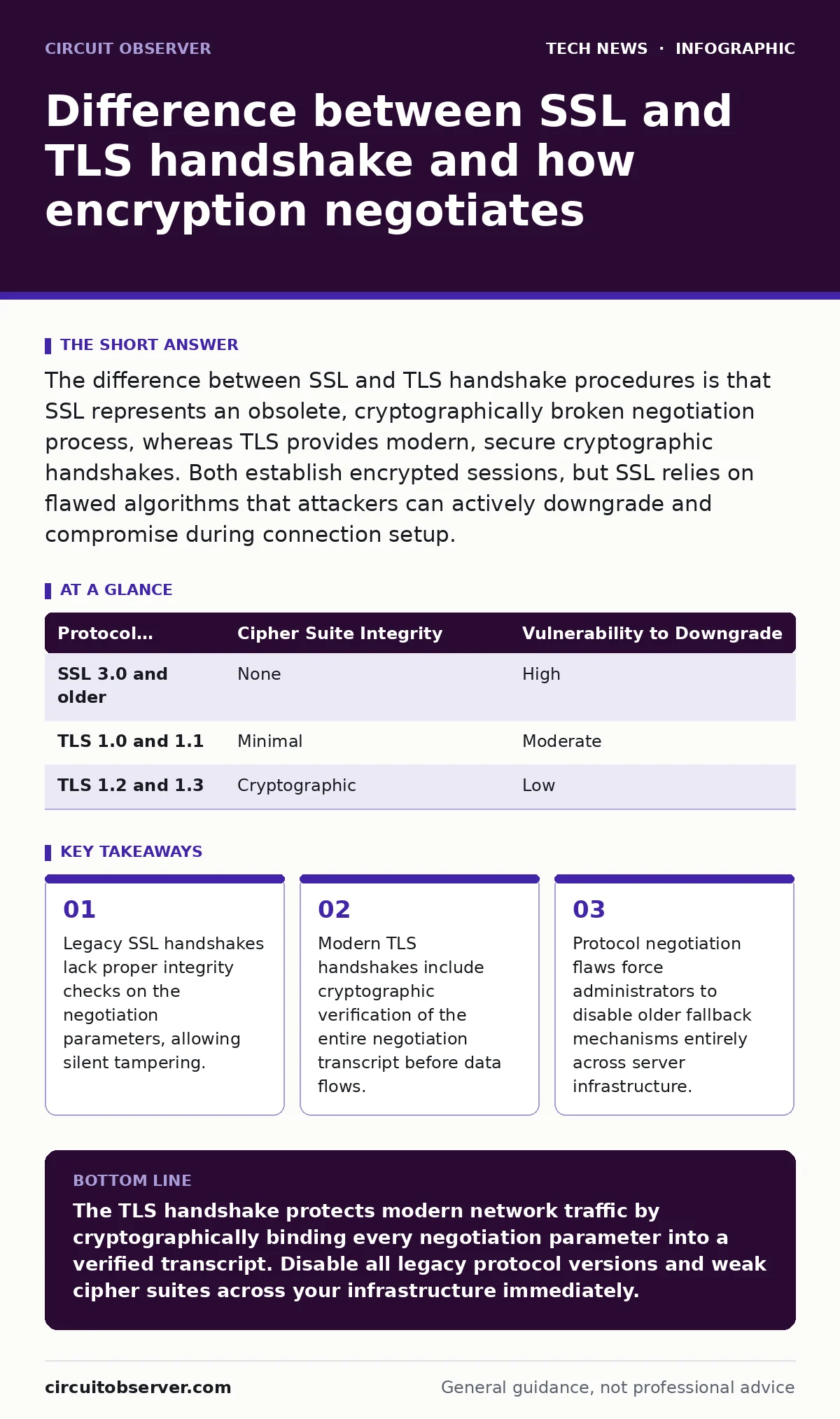
The difference between SSL and TLS handshake procedures is that SSL represents an obsolete, cryptographically broken negotiation process, whereas TLS provides modern, secure cryptographic handshakes. Both establish encrypted sessions, but SSL relies on flawed algorithms that attackers can actively downgrade and compromise during connection setup.
What is the exact difference between SSL and TLS handshake protocols?
The difference between SSL and TLS handshake mechanisms is that obsolete Secure Sockets Layer protocols use insecure cryptographic primitives, while Transport Layer Security enforces modern cryptographic verification. Both protocols establish parameters for secure sessions between clients and servers. However, the older method fails to protect the negotiation messages themselves from malicious modification.
An attacker sitting between a client and a server can alter the advertised cipher suites during an SSL negotiation. This adversary forces both endpoints to select weak, export-grade encryption algorithms that decryption tools crack in minutes. Modern TLS handshakes prevent this manipulation by cryptographically binding the entire message exchange into a final verification step.
| Protocol Generation | Cipher Suite Integrity | Vulnerability to Downgrade |
|---|---|---|
| SSL 3.0 and older | None | High |
| TLS 1.0 and 1.1 | Minimal | Moderate |
| TLS 1.2 and 1.3 | Cryptographic | Low |
Why do connection negotiations fail during cryptographic parameter agreement?
Connection negotiations fail when the client and server share no overlapping cryptographic algorithms or supported protocol versions. Every endpoint advertises a specific list of cipher suites, which combine asymmetric key exchange methods, symmetric encryption algorithms, and hashing functions. If administrative hardening policies disable older algorithms on one end, the handshake terminates immediately with an alert message.
Misconfigured intermediate certificates frequently trigger these negotiation failures by breaking the trust chain before key exchange begins. Clients validate the server certificate against local trust stores during the handshake sequence. When an intermediate certificate is missing from the server configuration, the client rejects the identity proof and aborts the connection.
How does the client Hello message initiate secure session creation?
The client Hello message initiates secure session creation by transmitting supported cryptographic versions, random byte strings, and cipher preferences to the target server. This opening transmission starts the negotiation sequence without encrypting the payload. The random values sent by both sides ensure that every generated session key remains completely unique, preventing replay attacks from recording past traffic.
Extensions inside the client Hello specify parameters like server name indication, which allows a single IP address to host multiple secure domains. Without this extension, the server cannot determine which cryptographic certificate to present to the connecting client. The server responds with its chosen parameters in the server Hello message, finalizing the foundational rules for the upcoming key exchange.
What happens during the asymmetric key exchange phase?
The asymmetric key exchange phase establishes a shared secret between client and server without transmitting that secret across the public network. Endpoints use public-key cryptography, such as Diffie-Hellman or Rivest-Shamir-Adleman, to negotiate the master secret. This mathematical process ensures that eavesdropping observers cannot calculate the shared secret even if they record every packet of the handshake.
Modern TLS implementations favor ephemeral Diffie-Hellman key exchanges over static RSA key transport. Ephemeral variants generate brand-new key pairs for every single connection and discard them immediately afterward. This behavior provides perfect forward secrecy, meaning that a compromised long-term private key cannot decrypt previously recorded network traffic.
Why do modern protocols finish handshakes with verified message transcripts?
Modern protocols finish handshakes with verified message transcripts to prevent adversaries from tampering with the negotiated parameters. Once both endpoints calculate the shared secret, they exchange cryptographic hashes of all handshake messages sent and received up to that point. Each side verifies this hash independently to confirm that no man-in-the-middle attacker altered the cipher suite selection or the random values.
This transcript verification step solves a historic vulnerability where attackers could strip strong ciphers from the initial greeting. If an adversary modifies the transcript during transit, the resulting hash values will not match on either endpoint. The connection drops instantly before any sensitive application data crosses the network boundary.
How do session resumption mechanisms accelerate subsequent connection setups?
Session resumption mechanisms accelerate subsequent connection setups by bypassing the full cryptographic negotiation and key exchange phases. Establishing a secure connection from scratch requires multiple round-trip times and heavy mathematical computation for asymmetric operations. Resumption allows returning clients and servers to reuse previously established cryptographic material, cutting connection latency drastically.
- Session identifiers store shared master secrets in server-side memory caches for fast lookups.
- Session tickets encrypt the cryptographic state and send it to the client for safe storage.
- Pre-shared keys embedded in modern protocol handshakes reduce setup overhead to zero round trips under optimal conditions.
Understanding these foundational connection concepts helps administrators properly configure network infrastructure, much like mapping out the OSI model to diagnose transport layer anomalies across complex enterprise environments.
What causes downgrade attacks during protocol negotiation?
Downgrade attacks occur when malicious actors actively manipulate unencrypted negotiation messages to force endpoints into using legacy protocols. Attackers intercept the initial greeting and remove support for modern protocol versions, tricking the server and client into communicating via obsolete methods. Once the endpoints fall back to these legacy methods, the adversary exploits known weaknesses in the older cryptographic implementation.
Protocol designers added specific signaling cipher suites to modern handshakes to detect and block this exact manipulation. If a client supports a modern protocol but receives a forced fallback signal, it aborts the connection immediately. Administrators must also disable fallback mechanisms at the application layer to ensure that systems reject outdated protocol versions without exception.
Key takeaways
- Legacy SSL handshakes lack proper integrity checks on the negotiation parameters, allowing silent tampering.
- Modern TLS handshakes include cryptographic verification of the entire negotiation transcript before data flows.
- Protocol negotiation flaws force administrators to disable older fallback mechanisms entirely across server infrastructure.
The TLS handshake protects modern network traffic by cryptographically binding every negotiation parameter into a verified transcript. Disable all legacy protocol versions and weak cipher suites across your infrastructure immediately.
Frequently asked questions
Can an expired certificate break a TLS handshake?
An expired certificate breaks the handshake because the client validates the validity dates during the authentication phase and rejects the connection immediately.
Why do some browsers show warnings about weak cipher suites?
Browsers show warnings because the server offers outdated encryption algorithms that fail to provide adequate security against modern computing power.
Does session resumption compromise forward secrecy?
Session resumption does not automatically compromise forward secrecy if the implementation utilizes ephemeral keys and rotates ticket encryption keys regularly.
What is server name indication and why is it needed?
Server name indication is a protocol extension that sends the target hostname in the clear during the initial greeting, allowing a single server to host multiple certificates.
How this guide was produced: written by the Circuit Observer editorial team with AI assistance, checked against the public references listed below, and reviewed when the facts change. See our editorial policy or report an error.