
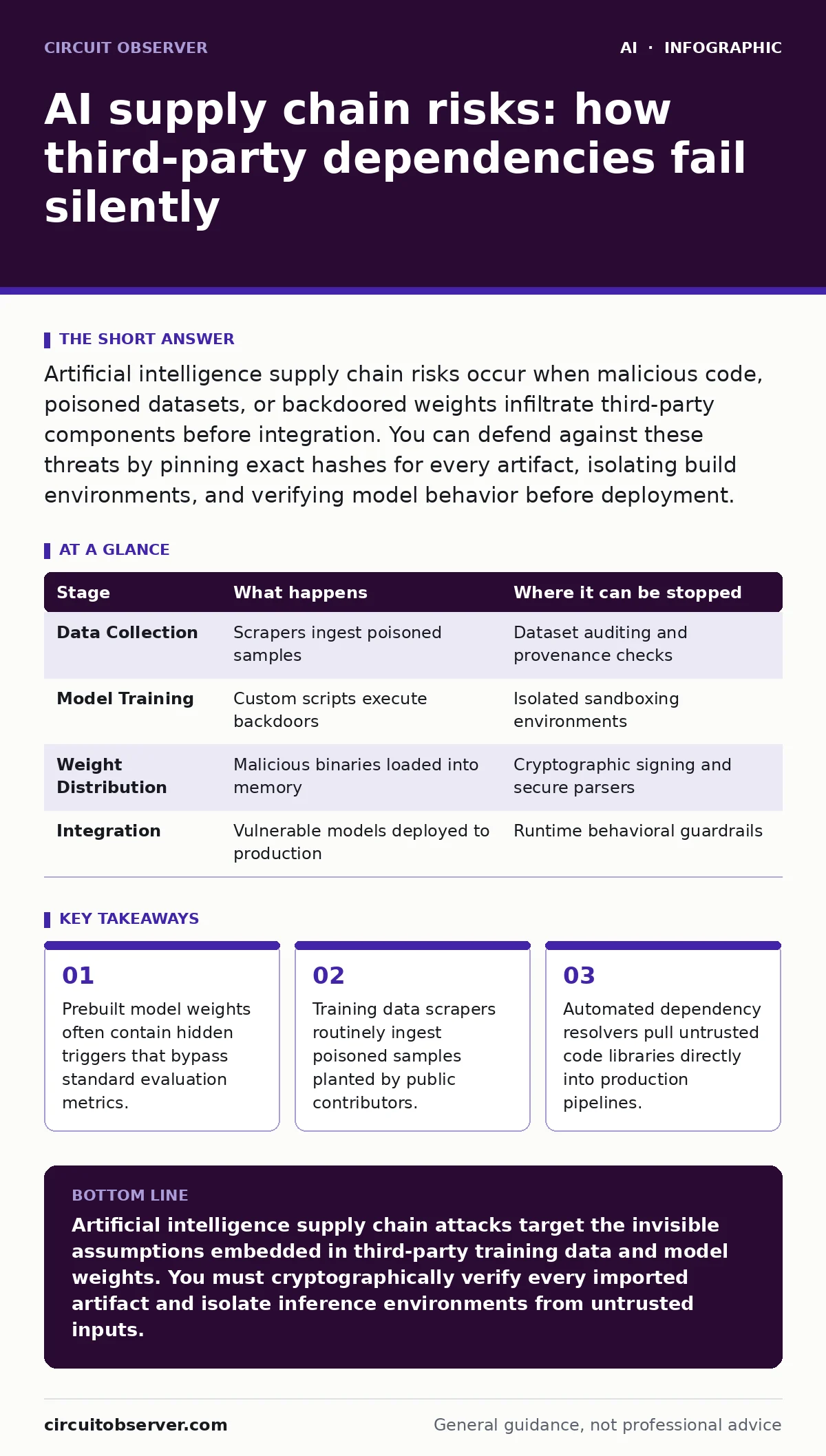
Artificial intelligence supply chain risks occur when malicious code, poisoned datasets, or backdoored weights infiltrate third-party components before integration. You can defend against these threats by pinning exact hashes for every artifact, isolating build environments, and verifying model behavior before deployment.
Anatomy of a Model Supply Chain
Artificial intelligence supply chain vulnerabilities stem from the reliance on external components during development. Modern machine learning projects rarely start from scratch, depending instead on pre-trained models, third-party libraries, and scraped datasets. Software bill of materials tracking, which lists every integrated component, often fails to capture the internal logic of neural network weights. Attackers exploit this blind spot by injecting malicious behaviors directly into public repositories where automated scanners search only for known vulnerabilities.
Stage 1: Data Poisoning and Collection
Data collection pipelines ingest massive volumes of uncurated text, images, and code from the public internet. Data poisoning happens when malicious actors intentionally publish altered samples designed to corrupt the statistical relationships learned by the model.
- Scrapers pull down millions of documents without verifying authorship or integrity.
- Label manipulation flips correct classifications during preprocessing steps.
- Filter bypass techniques disguise toxic content inside seemingly benign files.
Data provenance tracking and rigorous dataset auditing interrupt this stage before training begins.
Stage 2: Model Training and Fine-Tuning
Training infrastructure relies on complex frameworks and third-party orchestration scripts to process raw inputs. Model fine-tuning, the process of adapting a generalized neural network for a specific task, introduces fresh opportunities for compromise.
- Compute clusters execute untrusted Python scripts supplied by external contributors.
- Custom loss functions contain hidden backdoors that activate upon specific trigger inputs.
- Hyperparameter optimization loops download external modules without cryptographic verification.
Strict sandboxing and isolated execution environments interrupt attacks during the training phase.
Stage 3: Weight Serialization and Distribution
Model weights represent the learned parameters of a neural network stored in binary files. Weight serialization formats allow these complex matrices to be saved and loaded across different systems, but many popular formats permit arbitrary code execution when loaded.
- Malicious actors upload backdoored models to public model hubs disguised as high-performance variants.
- Archive decompression routines inside loading libraries execute embedded scripts automatically.
- Checksums match publicly visible hashes while internal tensor values contain malicious perturbations.
Cryptographic signing and secure parsing libraries interrupt threats at the distribution boundary.
Stage 4: Integration and Deployment
Integration pipelines combine downloaded weights with application code, vector databases, and inference servers. Vector databases, which store numerical representations of data for fast retrieval, can ingest poisoned embeddings that misdirect application logic during runtime execution.
- Inference containers mount untrusted model volumes directly into production memory spaces.
- API gateways route user queries through unverified tokenizers and preprocessing filters.
- Monitoring systems log standard performance metrics while missing subtle behavioral anomalies.
Runtime behavioral guardrails and strict privilege restrictions interrupt exploits during deployment.
Lifecycle Risk Summary
| Stage | What happens | Where it can be stopped |
|---|---|---|
| Data Collection | Scrapers ingest poisoned samples | Dataset auditing and provenance checks |
| Model Training | Custom scripts execute backdoors | Isolated sandboxing environments |
| Weight Distribution | Malicious binaries loaded into memory | Cryptographic signing and secure parsers |
| Integration | Vulnerable models deployed to production | Runtime behavioral guardrails |
See also: Large Language Models as Optimizers: Why Your Code Changes Break · Injection attacks examples: how prompt leaks break AI systems
Hidden Costs of Component Reuse
Third-party dependencies trade operational speed for systemic fragility. When you import external model architectures, you inherit every architectural flaw, hidden bias, and compromised dependency embedded by the original creators. Automated dependency updaters can introduce regressions or malicious patches faster than manual security teams can review them. Managing this surface area requires treating model weights with the same skepticism traditionally reserved for executable binaries.
Breaking the Chain of Compromise
Interruption points must be integrated into every phase of the development lifecycle to catch compromised artifacts. Traditional vulnerability scanners fail against machine learning components because the malicious payload resides in statistical weights rather than executable code. Building a resilient pipeline requires combining static analysis of configuration files with dynamic probing of model responses before promotion to production environments.
Key takeaways
- Prebuilt model weights often contain hidden triggers that bypass standard evaluation metrics.
- Training data scrapers routinely ingest poisoned samples planted by public contributors.
- Automated dependency resolvers pull untrusted code libraries directly into production pipelines.
Artificial intelligence supply chain attacks target the invisible assumptions embedded in third-party training data and model weights. You must cryptographically verify every imported artifact and isolate inference environments from untrusted inputs.
Frequently asked questions
How do malicious model weights bypass traditional security scanners?
Traditional scanners look for known vulnerability signatures in code, whereas malicious machine learning weights store their malicious logic in statistical parameters that appear as normal floating-point numbers.
Can automated dependency updates protect an artificial intelligence pipeline?
Automated updates often introduce risk by pulling in newly compromised packages or backdoored model versions without human review or cryptographic verification.
Why are scraped datasets dangerous for enterprise deployments?
Scraped datasets frequently contain poisoned samples and toxic content planted by anonymous contributors to skew model outputs or extract training data.
What is the most effective way to secure a model loading pipeline?
Using secure parsing libraries that prevent arbitrary code execution during deserialization combined with strict cryptographic hash pinning stops unauthorized weight modifications.
How this guide was produced: written by the Circuit Observer editorial team with AI assistance, checked against the public references listed below, and reviewed when the facts change. See our editorial policy or report an error.