
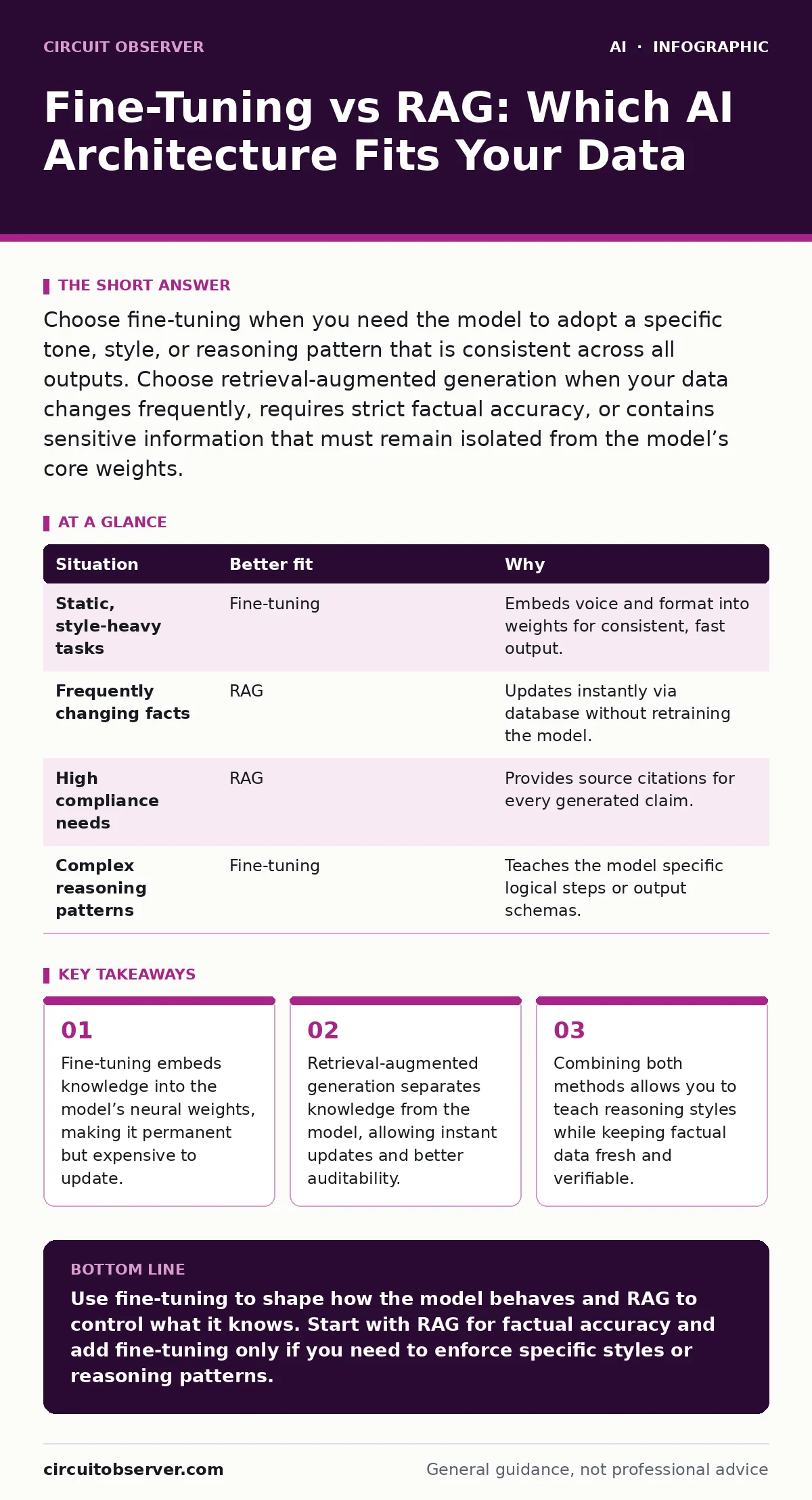
Choose fine-tuning when you need the model to adopt a specific tone, style, or reasoning pattern that is consistent across all outputs. Choose retrieval-augmented generation when your data changes frequently, requires strict factual accuracy, or contains sensitive information that must remain isolated from the model’s core weights.
Does your data change faster than your retraining cycle?
Retrieval-augmented generation (RAG) is built for volatility. It works by keeping your documents in a separate vector database and retrieving relevant snippets at the moment a user asks a question. This means if you update a policy document today, the AI reflects that change immediately without any retraining.
Fine-tuning, by contrast, bakes information into the model’s weights. Once you train the model, that knowledge is fixed. To update it, you must retrain the entire model or fine-tune it again, which consumes significant compute resources and time.
Imagine you manage a help desk for a software product that releases weekly updates. If you fine-tune your model on the documentation, it will become outdated within days. RAG pulls the latest documentation directly, ensuring the answer matches the current version.
Do you need to change behavior or just facts?
Fine-tuning is the correct choice when you want to change how the model thinks, not just what it knows. It excels at teaching a specific voice, formatting style, or reasoning structure. If you need the model to output JSON in a specific schema or adopt a formal tone, fine-tuning adjusts the probability distributions of token generation to favor those patterns.
RAG cannot teach style. It can only provide context. If your base model is chatty and informal, adding a formal document via RAG will not make the answer formal. It will simply quote the formal text within a chatty response.
Suppose you need an AI that writes legal summaries. A general model might write in plain English. Fine-tuning it on past legal summaries teaches it the structure, terminology, and cautionary phrasing unique to that field. RAG would only provide the source texts, leaving the model to decide how to synthesize them, likely failing to match the required professional tone.
Is hallucination a critical failure mode?
Hallucination occurs when a model generates plausible-sounding but incorrect information. Fine-tuning reduces the likelihood of factual errors by training the model on your specific ground truth. However, it does not eliminate them. The model may still mix up facts or invent details if the training data was ambiguous or insufficient.
RAG provides a verifiable chain of custody. Because the model generates answers based on retrieved documents, you can show the user exactly which source snippet supported the claim. This traceability is a major advantage for compliance and trust.
If you are dealing with high-stakes domains like healthcare or finance, the ability to point to the source document is often more valuable than a slightly faster response from a fine-tuned model. You can read more about managing these risks in our guide on sensitive data leaks through AI chatbots.
Are you constrained by compute and storage costs?
Fine-tuning requires significant upfront investment. You need powerful GPUs to train the model, and the resulting model file is larger than the base model. Every time you want to update the knowledge, you pay for compute again.
RAG shifts the cost to storage and search. You need a vector database to store your documents and an embedding model to convert text into searchable vectors. These costs are generally lower and scale linearly with the amount of data.
However, RAG has a hidden cost: complexity. You must manage the vector database, tune the retrieval parameters, and handle edge cases where the retrieval fails to find relevant documents. If the retrieval is poor, the answer will be poor, regardless of how smart the base model is.
| Situation | Better fit | Why |
|---|---|---|
| Static, style-heavy tasks | Fine-tuning | Embeds voice and format into weights for consistent, fast output. |
| Frequently changing facts | RAG | Updates instantly via database without retraining the model. |
| High compliance needs | RAG | Provides source citations for every generated claim. |
| Complex reasoning patterns | Fine-tuning | Teaches the model specific logical steps or output schemas. |
When to use both together
The most powerful systems often combine both approaches. You can fine-tune a model to adopt a specific persona or reasoning style, and then use RAG to inject up-to-date facts. This hybrid approach gives you the best of both worlds: consistent behavior and accurate, verifiable information.
For example, you might fine-tune a model to act as a strict code reviewer, teaching it to prioritize security vulnerabilities. Then, you use RAG to provide the latest security patches and company-specific coding standards. The model applies its learned security mindset to the fresh data provided by the retrieval system.
This combination requires careful orchestration. You must ensure the retrieved context does not conflict with the fine-tuned instructions. If the retrieval brings in contradictory information, the model may become confused. Proper prompt engineering is needed to tell the model how to weigh the retrieved facts against its internalized style.
If you are implementing this, consider how you will monitor the system over time. Our guide on AI model monitoring offers strategies for tracking drift and accuracy in complex pipelines. Additionally, understanding tokens in language models will help you manage the context window limits when combining large retrieved chunks with system prompts.
Key takeaways
- Fine-tuning embeds knowledge into the model’s neural weights, making it permanent but expensive to update.
- Retrieval-augmented generation separates knowledge from the model, allowing instant updates and better auditability.
- Combining both methods allows you to teach reasoning styles while keeping factual data fresh and verifiable.
Use fine-tuning to shape how the model behaves and RAG to control what it knows. Start with RAG for factual accuracy and add fine-tuning only if you need to enforce specific styles or reasoning patterns.
Frequently asked questions
Can RAG replace the need for a large language model?
No, RAG requires a language model to synthesize the retrieved information into a coherent answer. It is a technique that augments the model, not a replacement for it.
Is fine-tuning safer than RAG for private data?
Fine-tuning embeds data into the model weights, which can be harder to extract or audit. RAG keeps data in a separate database, allowing you to delete specific records without retraining the model, offering better data governance.
How do I know if my retrieval is working correctly?
Monitor the relevance of the retrieved snippets. If users frequently complain about irrelevant or missing information, your retrieval parameters or embedding model may need adjustment. See our guide on AI security testing for validation methods.
Can I fine-tune a model on too much data?
Yes, adding too much diverse data can dilute the specific patterns you are trying to teach. Keep fine-tuning datasets focused and high-quality to avoid degrading the model’s general capabilities.
How this guide was produced: written by the Circuit Observer editorial team with AI assistance, checked against the public references listed below, and reviewed when the facts change. See our editorial policy or report an error.