
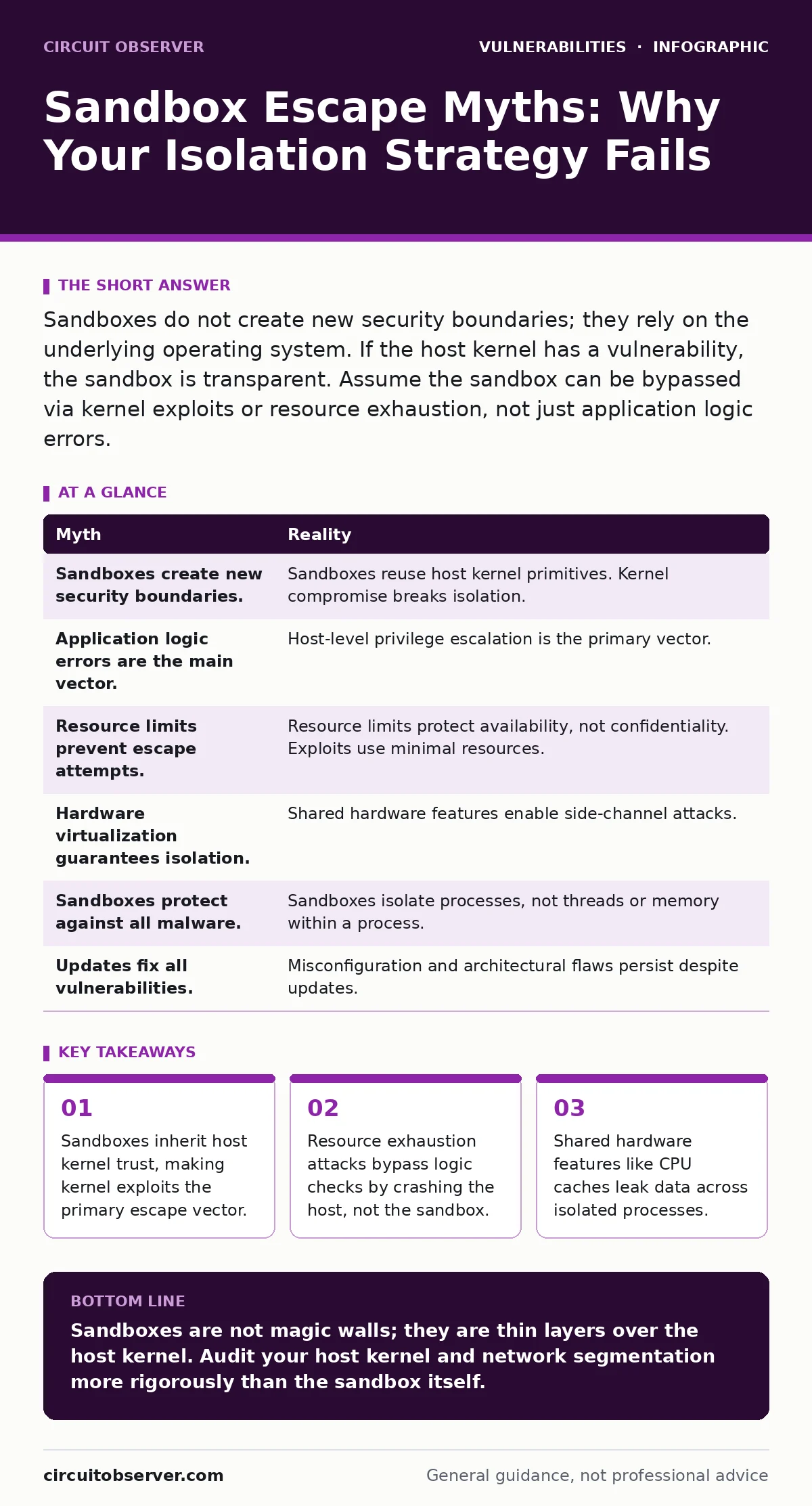
Sandboxes do not create new security boundaries; they rely on the underlying operating system. If the host kernel has a vulnerability, the sandbox is transparent. Assume the sandbox can be bypassed via kernel exploits or resource exhaustion, not just application logic errors.
Myth: Sandboxes Create New Security Boundaries
Reality: Sandboxes reuse existing operating system primitives. They do not invent new isolation mechanisms. A sandbox typically relies on namespaces, cgroups, or capability drops provided by the host kernel. If an attacker compromises the kernel, the sandbox offers no protection. The boundary is not the sandbox software; it is the kernel code.
Imagine a container running untrusted code. The container uses Linux namespaces to hide the host file system. An attacker finds a buffer overflow in the Linux kernel’s memory manager. The exploit executes within the kernel context. The namespace restrictions vanish instantly. The attacker now controls the entire host. The sandbox software was never breached; the foundation beneath it collapsed. This is why kernel hardening matters more than container hardening.
Myth: Application Logic Errors Are the Main Escape Vector
Reality: Most sandbox escapes stem from host-level privilege escalation. Attackers rarely find bugs in the sandbox manager itself. They find bugs in the libraries, drivers, or kernel modules shared by the sandbox and the host. The sandbox restricts what the application can do, but it cannot stop the application from triggering a kernel panic.
Suppose a sandbox blocks all outbound network connections. The attacker cannot exfiltrate data over the network. Instead, the attacker triggers a race condition in a shared graphics driver. The driver runs in kernel space. The race condition allows the attacker to write to arbitrary memory addresses. The attacker modifies the host’s user database. The sandbox’s network rule is irrelevant. The damage occurred before any network traffic could be generated.
Myth: Resource Limits Prevent Escape Attempts
Reality: Resource limits protect availability, not confidentiality. Limiting CPU or memory usage stops denial-of-service attacks. It does not stop an attacker from using minimal resources to exploit a kernel vulnerability. A single instruction can trigger a buffer overflow. Resource limits cannot distinguish between a heavy workload and a malicious exploit.
Consider a sandbox that caps memory usage at 512 megabytes. The attacker needs only a few kilobytes to craft a shellcode payload. The sandbox allows this small allocation. The payload executes and triggers a heap overflow in a shared library. The library is part of the host system. The overflow grants root access. The resource limit worked perfectly. It prevented a crash. It failed to prevent an escape.
Myth: Hardware Virtualization Guarantees Isolation
Reality: Hardware virtualization reduces the attack surface. It does not eliminate it. Hypervisors are complex software stacks. They contain bugs. Furthermore, hardware features like CPU caches and branch predictors are shared across virtual machines. These shared resources can leak data. Side-channel attacks exploit these physical characteristics. The isolation is logical, not physical.
Imagine two virtual machines running on the same physical CPU. Machine A runs untrusted code. Machine B runs sensitive data. The CPU uses a shared cache to speed up operations. Machine A measures how long it takes to access specific cache lines. By analyzing these timing differences, Machine A infers data from Machine B. No software bug exists. No code is injected. The hardware design itself allows the leak. This is a fundamental limitation of shared multi-core processors.
Myth: Sandboxes Protect Against All Malware Types
Reality: Sandboxes are designed to contain untrusted code. They are not designed to protect against all threats. Fileless malware, for example, runs in memory and may never touch the disk. If the malware resides in the same process space as the sandbox manager, it bypasses the sandbox entirely. The sandbox isolates processes, not threads within a process.
Suppose an attacker injects code into a legitimate browser process. The browser runs inside a sandbox. The sandbox restricts file access. The injected code does not need file access. It reads the browser’s memory directly. It steals session cookies. The sandbox prevents the code from writing to the disk. It does not prevent the code from reading the memory it already shares. The isolation boundary is too coarse.
Myth: Updates Fix All Sandbox Vulnerabilities
Reality: Updates patch known bugs. They do not fix architectural flaws. If the sandbox architecture relies on a flawed assumption, updates cannot fix it. For example, if the sandbox assumes the host kernel is trustworthy, no amount of sandbox patching will help. You must update the host kernel. You must also audit the configuration. Misconfiguration is often more dangerous than code bugs.
Consider a sandbox that uses SELinux policies. The policy is complex. An administrator disables a rule to fix a permission error. This small change opens a path for escape. The sandbox software is up to date. The kernel is up to date. The configuration is wrong. The sandbox fails because human error introduced a gap. Regular audits of configuration files are necessary. Code updates are insufficient.
Myth: Sandboxes Replace Need for Network Segmentation
Reality: Sandboxes isolate processes. They do not isolate network traffic. If a sandboxed process is compromised, it can still communicate with other services on the network. The sandbox prevents the process from accessing local files. It does not prevent it from sending commands to a database server. Network segmentation limits the blast radius. Sandboxes do not.
Imagine a web application running in a sandbox. An attacker exploits a SQL injection vulnerability in the application. The database is on a different server. The sandbox prevents the attacker from reading local files. The attacker uses the SQL injection to execute commands on the database server. The sandbox did not stop the lateral movement. The network allowed it. Proper broken access control policies on the network are required.
Summary of Sandbox Escape Myths
| Myth | Reality |
|---|---|
| Sandboxes create new security boundaries. | Sandboxes reuse host kernel primitives. Kernel compromise breaks isolation. |
| Application logic errors are the main vector. | Host-level privilege escalation is the primary vector. |
| Resource limits prevent escape attempts. | Resource limits protect availability, not confidentiality. Exploits use minimal resources. |
| Hardware virtualization guarantees isolation. | Shared hardware features enable side-channel attacks. |
| Sandboxes protect against all malware. | Sandboxes isolate processes, not threads or memory within a process. |
| Updates fix all vulnerabilities. | Misconfiguration and architectural flaws persist despite updates. |
Key takeaways
- Sandboxes inherit host kernel trust, making kernel exploits the primary escape vector.
- Resource exhaustion attacks bypass logic checks by crashing the host, not the sandbox.
- Shared hardware features like CPU caches leak data across isolated processes.
Sandboxes are not magic walls; they are thin layers over the host kernel. Audit your host kernel and network segmentation more rigorously than the sandbox itself.
Frequently asked questions
How do I detect a sandbox escape attempt?
Monitor for unexpected kernel module loads, unusual process parent-child relationships, and sudden changes in system call rates. Look for processes trying to access resources outside their defined namespace.
Are containers safer than virtual machines?
Containers share the host kernel, making them more susceptible to kernel exploits. Virtual machines use a hypervisor, which adds a layer of abstraction. However, both rely on underlying hardware and software that can be compromised.
Can I secure a sandbox against side-channel attacks?
You can mitigate them by isolating sensitive workloads on dedicated hardware. Software mitigations exist but often reduce performance. Complete elimination requires physical separation of processing units.
Should I use multiple sandbox layers?
Layering adds defense depth. If one layer fails, another may stop the attacker. However, each layer adds complexity and potential misconfiguration risks. Ensure each layer is correctly configured before adding more.
How this guide was produced: written by the Circuit Observer editorial team with AI assistance, checked against the public references listed below, and reviewed when the facts change. See our editorial policy or report an error.