
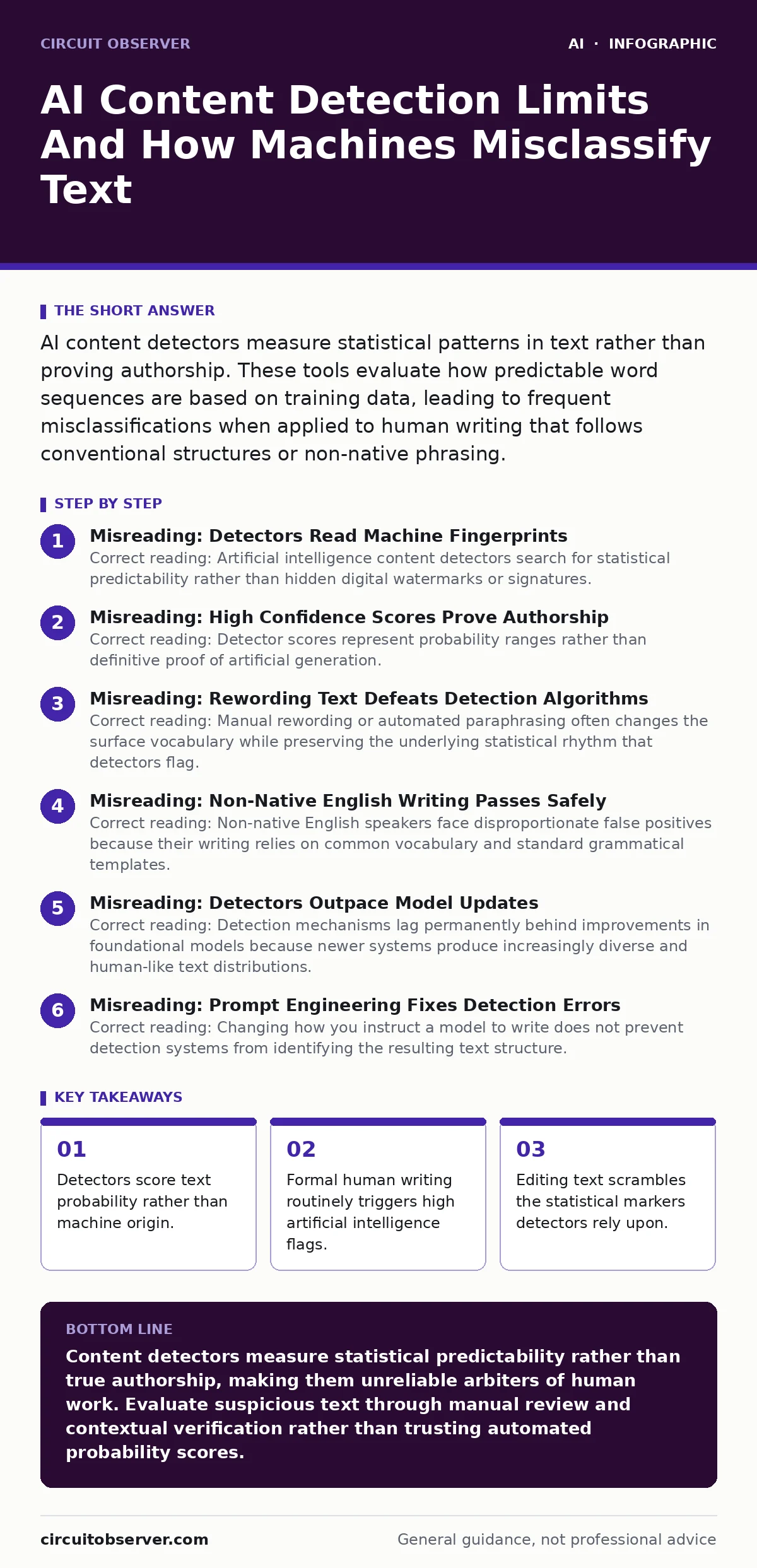
AI content detectors measure statistical patterns in text rather than proving authorship. These tools evaluate how predictable word sequences are based on training data, leading to frequent misclassifications when applied to human writing that follows conventional structures or non-native phrasing.
Misreading: Detectors Read Machine Fingerprints
Correct reading: Artificial intelligence content detectors search for statistical predictability rather than hidden digital watermarks or signatures. Large language models generate text by predicting the most likely next word based on mathematical weights assigned to sequences of tokens in language models. Detectors measure this same metric, flagging text as machine-made when word choices are unusually uniform or mathematically expected.
Predictable writing patterns trigger false positives because human authors often write in structured, formulaic ways. Technical documentation, academic abstracts, and legal summaries rely on standard phrasing that mimics the output distribution of statistical models. A detector evaluates the predictability of word combinations rather than the underlying intent or creator of the sentence.
Misreading: High Confidence Scores Prove Authorship
Correct reading: Detector scores represent probability ranges rather than definitive proof of artificial generation. A numerical output indicating high confidence reflects only the degree of statistical uniformity found within the analyzed sample length.
False certainty arises because short text snippets lack enough linguistic variance for reliable scoring. A single paragraph written by a human can easily display the narrow distribution curves that algorithms associate with automated systems. Treating probability scores as binary truths ignores the fundamental overlap between formalized human expression and machine output.
Misreading: Rewording Text Defeats Detection Algorithms
Correct reading: Manual rewording or automated paraphrasing often changes the surface vocabulary while preserving the underlying statistical rhythm that detectors flag. Modifying individual words using synonyms fails to disrupt the broader syntactic structures that automated systems analyze across an entire paragraph.
Paraphrasing tools rely on similar probabilistic weightings as the original generators, inadvertently maintaining the predictable cadences that trigger detection flags. Disrupting these patterns requires injecting irregular syntax, unpredictable metaphors, and erratic sentence lengths that contradict standard statistical optimization.
Misreading: Non-Native English Writing Passes Safely
Correct reading: Non-native English speakers face disproportionate false positives because their writing relies on common vocabulary and standard grammatical templates. Language learners often choose predictable, highly probable phrasing to ensure clarity, which closely mirrors the output generation style of language models.
Automated grading systems and detectors misinterpret this structural simplicity as automated authorship. Writers who use standardized phrases to communicate clearly find their authentic work penalized by algorithms that equate linguistic conventionality with machine generation.
Misreading: Detectors Outpace Model Updates
Correct reading: Detection mechanisms lag permanently behind improvements in foundational models because newer systems produce increasingly diverse and human-like text distributions. As model creators refine their architectures to mimic nuanced human writing, the statistical gap between human and machine text narrows continuously.
Algorithms designed to catch older generations of models fail when confronted with newer text architectures that intentionally inject variability into their word choices. This ongoing arms race means that detection reliability degrades every time underlying text generation models undergo significant architectural upgrades.
Misreading: Prompt Engineering Fixes Detection Errors
Correct reading: Changing how you instruct a model to write does not prevent detection systems from identifying the resulting text structure. Prompt engineering shapes the semantic content and tone of the output, but it leaves the underlying mathematical predictability largely intact.
Asking a model to adopt a conversational persona or mimic a specific author adds stylistic flair without altering the fundamental token selection math. Detectors analyze the mathematical distribution of those tokens beneath the stylistic surface, rendering superficial prompt adjustments ineffective for avoiding classification.
Key takeaways
- Detectors score text probability rather than machine origin.
- Formal human writing routinely triggers high artificial intelligence flags.
- Editing text scrambles the statistical markers detectors rely upon.
Content detectors measure statistical predictability rather than true authorship, making them unreliable arbiters of human work. Evaluate suspicious text through manual review and contextual verification rather than trusting automated probability scores.
Frequently asked questions
Can you watermark AI text to make detection reliable?
Cryptographic watermarking alters token selection probabilities during generation, but bad actors can strip these markers through translation or paraphrasing.
Why do false positives happen so often with technical writing?
Technical documentation relies on standard phrasing and predictable vocabulary that closely match the statistical patterns flagged by detectors.
Do longer texts make AI detectors more accurate?
Longer samples provide more data points, but they also increase the chance that a human author will use conventional phrasing that triggers a false positive.
How do educators misuse content detectors?
Instructors frequently treat probability scores as definitive proof of cheating, leading to unfair accusations against students who write in formal styles.
How this guide was produced: written by the Circuit Observer editorial team with AI assistance, checked against the public references listed below, and reviewed when the facts change. See our editorial policy or report an error.